
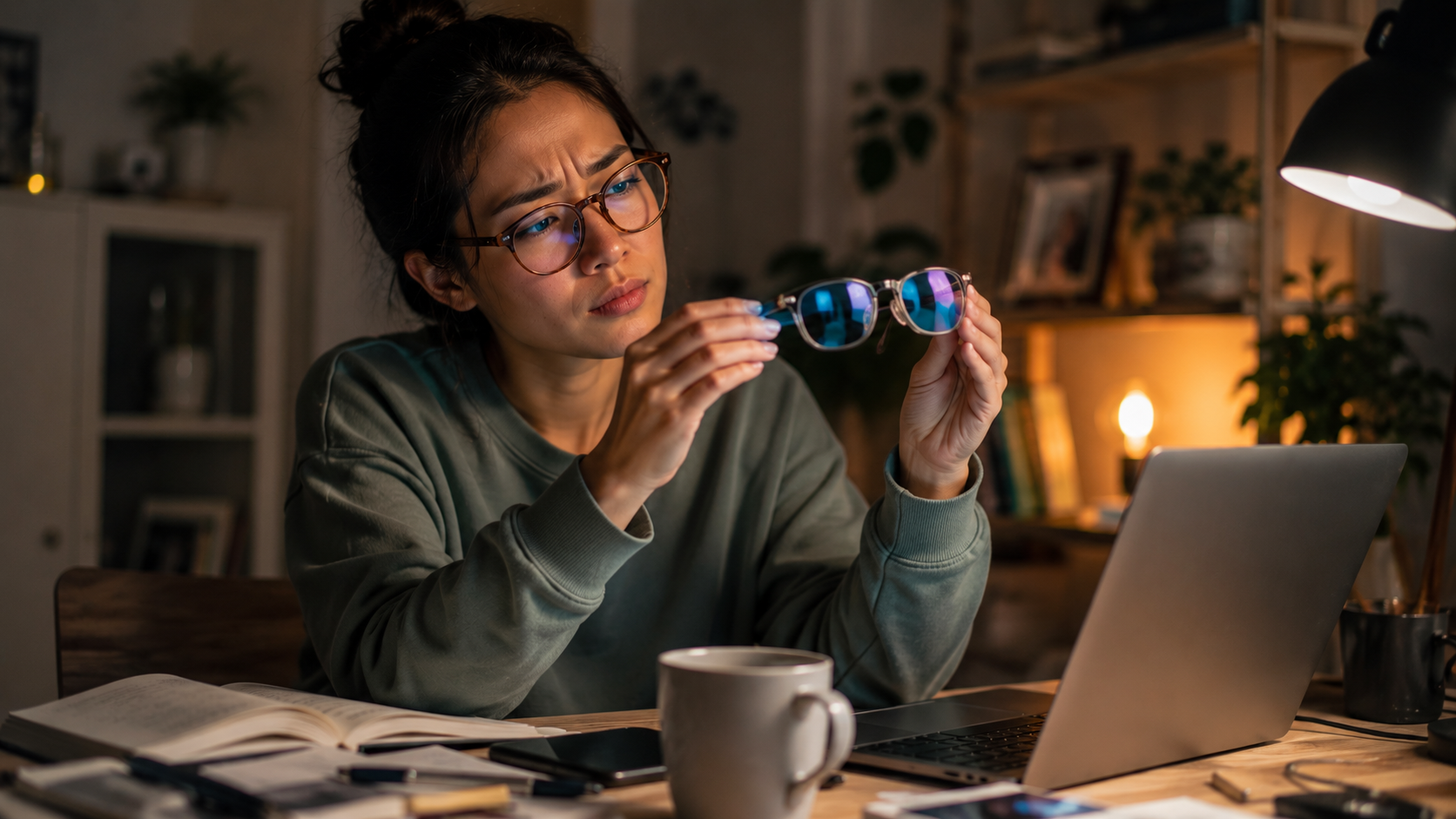
Blue-light glasses offer an appealing solution to screen fatigue: put on one pair of lenses, block the troublesome light, and make hours at a computer easier on your eyes.
The evidence is less impressive than the marketing.
Blue-light-filtering glasses have not been shown to relieve digital eye strain meaningfully better than ordinary lenses. A particular pair may still feel comfortable, but the benefit could come from the prescription, reduced reflections, tint, fit, or changed screen habits rather than the blue-light filter itself.
Screens can absolutely make your eyes feel tired. Blue light is usually not the main reason.
What Do Blue-Light Glasses Actually Do?
Blue light is part of the visible-light spectrum. It comes from sunlight, indoor lighting, phones, computers, and other displays.
Blue-light-filtering lenses reduce some of the shorter-wavelength visible light reaching the eyes. How much they filter varies widely.
Clear lenses marketed for daytime computer use usually block only a modest amount. Stronger filters tend to have a noticeable yellow, orange, or amber tint and may affect colour perception.
The 2023 Cochrane review of blue-light-filtering spectacle lenses notes that many commercial lenses filter roughly 10% to 25% of blue light.
So the lenses do change the light passing through them.
The important question is whether that change reduces eye strain.
What Does the Research Say?
The best current evidence does not show a meaningful short-term advantage.
The Cochrane review examined 17 randomized controlled trials involving 619 participants. Compared with lenses without blue-light filtering, the filtered lenses appeared to provide little or no benefit for computer-related visual fatigue.
The review also found:
- little or no meaningful difference in visual acuity
- uncertain and inconsistent effects on sleep
- no clinical trial evidence allowing conclusions about macular protection
- generally mild and infrequently reported adverse effects
The evidence was not perfect. Many studies were small, follow-up was short, products differed, and not every trial was well masked.
But scientific uncertainty does not transform a weakly supported claim into a strong one.
A separate systematic review and meta-analysis of treatments for computer vision syndrome also found that blue-blocking spectacles did not reduce visual-fatigue symptoms, although the evidence was judged low-certainty.
An individual double-masked randomized trial reached the same practical conclusion: blue-blocking lenses did not improve the signs or symptoms of eye strain compared with standard clear lenses.
The responsible summary is straightforward:
Current research does not support blue-light glasses as a reliable treatment for digital eye strain.
Why Do Some People Still Say They Help?
Someone can genuinely feel better while wearing blue-light glasses without the blue-light filter being the reason.
A pair of glasses includes more than one feature.
The prescription may be better
If the lenses correct astigmatism, farsightedness, presbyopia, or another refractive issue, screen work may become easier.
That improvement comes from appropriate optical correction, not necessarily from filtering blue light.
Reflections may be reduced
Some products also include anti-reflective coatings.
Reducing reflections from lamps, windows, and glossy displays can make a screen more comfortable to view. That is useful, but it is different from proving that blue wavelengths caused the symptoms.
The tint may feel more comfortable
Some people prefer warmer-looking lenses because white screens feel less harsh through them.
Subjective comfort still counts. It simply does not prove that blue light was damaging the eyes or causing the fatigue.
The glasses may change behaviour
Putting on “computer glasses” can remind someone to:
- sit farther from the screen
- increase the text size
- reduce glare
- take breaks
- stop working in a dark room
- pay attention to discomfort earlier
The surrounding habit may help even when the filter itself adds little.
A product can feel helpful without its headline explanation being correct.
What Usually Causes Digital Eye Strain?
Digital eye strain is more closely connected to how the task is performed than to blue light acting as a special form of visual poison.
Common contributors include:
- prolonged uninterrupted near work
- reduced or incomplete blinking
- dryness and tear-film instability
- small text
- close viewing distance
- glare and reflections
- poor brightness balance
- direct airflow from fans or heating
- uncomfortable screen position
- neck and shoulder tension
- an unsuitable or outdated prescription
- contact-lens discomfort
- focusing or eye-coordination difficulties
The American Academy of Ophthalmology’s guidance on digital devices explains that normal device use can cause temporary discomfort but has not been shown to damage the eyes permanently through screen light.
Consider what happens during an ordinary workday.
The same display may feel fine for the first thirty minutes and exhausting after several uninterrupted hours. The screen did not suddenly begin producing a different kind of light.
What changed was the duration, blinking pattern, posture, dryness, concentration, and accumulated load.
Eye Strain and Eye Damage Are Different Claims
Blue-light marketing often blends two ideas:
- the lenses reduce eye strain
- the lenses protect the retina from screen damage
The evidence does not strongly support either claim for normal computer and phone use.
The American Academy of Ophthalmology states that there is no scientific evidence that blue light from digital devices damages the eyes.
The College of Optometrists likewise says the best available evidence does not support blue-blocking lenses for reducing eye fatigue, improving visual performance, improving sleep, or preserving macular health in the general population.
This does not mean intense light can never injure the retina. Sunlight, lasers, and powerful specialised light sources are different exposures.
Laboratory studies using intense light or isolated cells should not be casually converted into claims that normal laptop use is slowly burning the retina.
Dose matters. Exposure matters. Context matters.
Marketing occasionally finds those details inconvenient.
What About Blue Light and Sleep?
Evening light can affect circadian timing, alertness, and melatonin regulation. Short-wavelength light can have a particularly strong biological effect.
That makes the sleep question more plausible than the eye-strain claim—but the evidence for blue-light glasses is still uncertain.
In the Cochrane review, six trials examined sleep-related outcomes. Three reported improvement and three found no significant difference. The studies involved different groups and products, so no confident conclusion could be drawn.
Several factors complicate the issue:
- many clear lenses may filter too little light to create a large circadian effect
- stronger amber lenses alter colour more noticeably
- room lighting also contributes to evening exposure
- screen brightness and duration still matter
- stimulating content can delay sleep even through a warmer display
- individual sleep patterns differ
The useful distinction is:
Blue-light glasses have not shown reliable benefit for digital eye strain, while their effect on sleep remains uncertain and may depend on the product, timing, and user.
For most people, reducing bright evening light and screen exposure is a more direct starting point than buying another transparent accessory.
Should You Buy Blue-Light Glasses?
There is no strong evidence-based reason for most people to pay extra for blue-light filtering specifically to prevent digital eye strain or retinal damage from ordinary screens.
That does not mean an existing pair must be thrown away.
Wearing them may be reasonable if:
- the prescription is accurate
- they feel comfortable
- colour changes do not interfere with your work
- the price is acceptable
- you understand what they are and are not likely to do
Before paying extra, ask:
- Do these lenses include a prescription?
- Do they have an anti-reflective coating?
- How much blue light do they filter?
- Are they clear or strongly tinted?
- Is the claim about comfort, sleep, or eye protection?
- What evidence supports that specific claim?
“Blue-light protection” sounds precise while describing products that may behave very differently.
What Is More Likely to Help Eye Strain?
The better-supported options are less exciting, largely because they cannot be placed in a premium-looking glasses case.
Interrupt prolonged near work
Look away regularly and view something genuinely farther away.
The exact numbers in the 20-20-20 rule are not magical. The useful part is breaking continuous near focus.
Blink completely
Concentrated screen use can reduce blinking or increase incomplete blinks.
Several slow, natural blinks can help restore the tear film when clarity or comfort is fluctuating.
Increase text size
Make the content easier to see instead of moving your face closer.
Tiny text is not a character-building exercise.
Reduce glare and balance brightness
Reposition lamps, blinds, or the screen to reduce reflections.
Avoid an extremely bright screen in a dark room or a display so dim that you begin squinting.
Improve viewing distance and posture
Sit far enough away that the screen can be viewed without leaning forward. Adjust text size before sacrificing your neck to the document.
Move airflow away from the eyes
Fans, heaters, and air-conditioning vents can increase tear evaporation when directed toward the face.
Check the prescription
If symptoms repeatedly return, an eye examination can identify refractive, focusing, coordination, contact-lens, or ocular-surface issues that no blue-light coating can correct.
Explore See Clarity Now for a structured approach to visual habits, comfort, and eye–brain performance.
The program supports better visual habits and working conditions. It does not replace prescription correction, diagnosis, an eye examination, or medical treatment.
When Persistent Eye Strain Needs Checking
Arrange an eye examination when:
- symptoms repeatedly interfere with work or reading
- blur remains after screen use ends
- headaches regularly accompany near work
- one eye consistently feels or sees differently
- contact lenses have become uncomfortable
- glasses no longer provide reliable clarity
- dryness, burning, light sensitivity, or double vision persists
Blue-light glasses should not become an expensive delay between a recurring symptom and a proper examination.
Final Takeaway
Blue-light glasses do filter some blue light.
What they have not reliably done in controlled research is reduce digital eye strain better than ordinary lenses.
A pair may still feel comfortable because of its prescription, anti-reflective coating, tint, fit, or the habits you use while wearing it. That does not prove that screen blue light was causing the problem.
For digital eye strain, investigate the wider pattern:
- task duration
- blinking
- dryness
- glare
- brightness
- viewing distance
- posture
- prescription
- recovery
The glasses are not necessarily useless.
The claim that they solve the problem is unsupported.
Find the Layer Creating the Most Friction
Screen discomfort may be primarily visual, or it may be interacting with focus, reading mechanics, memory, and daily rhythm.
Take the MindTecton Assessment to identify which layer is currently creating the most friction in how you work, learn, read, remember, and perform.
Sources
- Singh S, Keller PR, Busija L, et al. Blue-Light Filtering Spectacle Lenses for Visual Performance, Sleep, and Macular Health in Adults. Cochrane Database of Systematic Reviews. 2023.
https://pubmed.ncbi.nlm.nih.gov/37593770/ - Singh S, McGuinness MB, Anderson AJ, Downie LE. Interventions for the Management of Computer Vision Syndrome: A Systematic Review and Meta-Analysis. Ophthalmology. 2022.
https://pubmed.ncbi.nlm.nih.gov/35597519/ - Singh S, Keller PR, Busija L, et al. Do Blue-Blocking Lenses Reduce Eye Strain From Extended Screen Time? A Double-Masked Randomized Controlled Trial. American Journal of Ophthalmology. 2021.
https://pubmed.ncbi.nlm.nih.gov/33587901/ - American Academy of Ophthalmology. Digital Devices and Your Eyes.
https://www.aao.org/eye-health/tips-prevention/digital-devices-your-eyes - American Academy of Ophthalmology. Should You Be Worried About Blue Light?
https://www.aao.org/eye-health/tips-prevention/should-you-be-worried-about-blue-light - College of Optometrists. Blue-Blocking Spectacle Lenses: Position Statement.
https://www.college-optometrists.org/policy-and-influencing/position-statements/blue-blocking-spectacle-lenses