
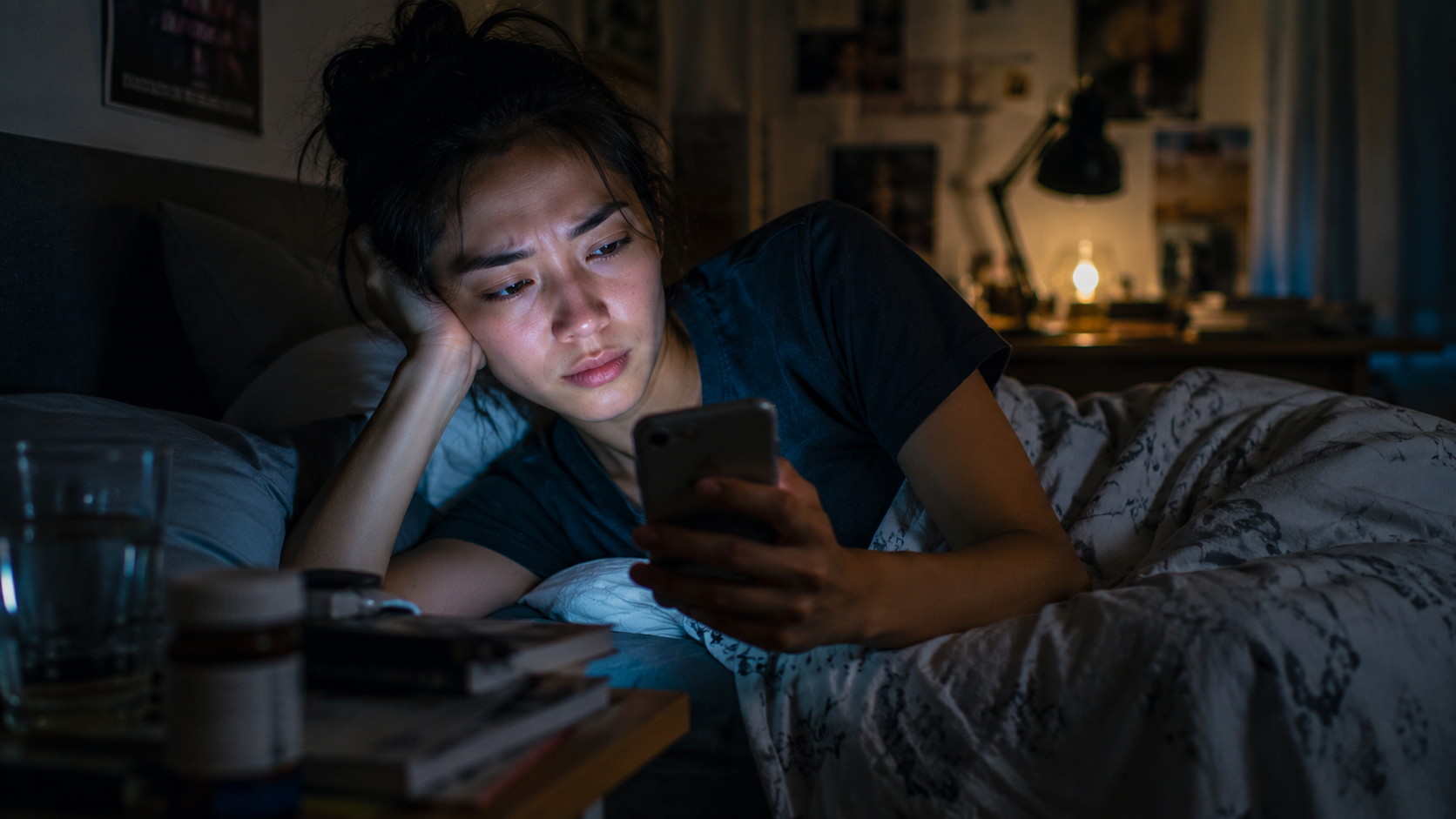
You finally put the phone down, sleep, and wake with eyes that feel dry, heavy, irritated, or slow to settle into focus.
The obvious suspect is blue light. The fuller explanation is less tidy—and more useful.
Late-night screen use can make your eyes feel worse the next day because it adds more close visual work when the system is already fatigued, changes blinking, destabilizes the tear film, and may delay or shorten sleep. Poor sleep can then make existing dryness, headaches, and visual discomfort harder to tolerate.
One late evening does not mean you damaged your eyes.
But repeatedly loading the visual system until bedtime and giving it weak recovery conditions can leave you starting the next morning already behind.
Late Screens Are Usually the Final Load, Not the First
By late evening, your eyes may already have spent hours on:
- computer work
- phone use
- reading
- television
- detailed near tasks
- contact lenses
- dry indoor air
- sustained concentration
The final screen session is rarely an isolated event. It is usually added to everything that came before.
That matters because visual strain is cumulative.
A phone that feels harmless for twenty minutes in the afternoon may feel very different after a full day of near work, missed breaks, small text, poor posture, and dry air.
A recent review of digital eye strain describes symptoms such as dryness, burning, blurred vision, and eye fatigue as part of a multifactorial problem involving blinking, tear stability, viewing conditions, workload, and visual correction.
The screen itself has not suddenly become more dangerous at 11:30 p.m.
Your tolerance for another hour of it may simply be lower.
Screen Use Can Change How You Blink
A stable tear film helps keep the surface of the eye comfortable and optically smooth.
Each complete blink redistributes that tear layer.
During concentrated screen use, people commonly blink less often or blink incompletely. The updated review of digital eye strain explains that longer intervals between blinks allow the tear film to break up before the next blink, while incomplete blinking leaves parts of the eye surface less evenly covered.
That can contribute to:
- burning
- grittiness
- fluctuating clarity
- heaviness
- watering
- temporary improvement after blinking
Late-night phone use can intensify the pattern because people often:
- hold the device close
- stare at small text
- scroll without natural stopping points
- use the screen in a dark room
- remain in one fixed position
- continue after discomfort has already started
A review of dry-eye disease and digital screen use likewise found that device use is associated with altered blinking behaviour and tear-film disturbance.
The responsible conclusion is not that every late screen session damages the eye surface.
It is that hours of screen use can leave the tear film less stable and the eyes less comfortable by the time you go to sleep.
Bedtime Screen Use Can Reduce Recovery Time
Late screens affect more than the eyes.
They can keep you awake through several different routes:
- the activity simply replaces sleep time
- messages and notifications delay disengagement
- emotionally engaging content maintains alertness
- bright evening light can influence circadian timing
- using a device in bed makes it easier to continue longer than intended
A 2025 study of adults found that screen use before sleep was associated with later bedtimes and shorter sleep duration.
That kind of study shows association, not proof that the screen caused every sleep problem. People who are stressed, busy, or already unable to sleep may also use devices more.
Still, one part of the mechanism is refreshingly uncomplicated:
If you intended to sleep at 11:00 but scrolled until midnight, the screen did not need advanced neuroscience to reduce your sleep by an hour.
It merely needed your thumb.
Poor Sleep and Eye Discomfort Often Travel Together
Research increasingly suggests that sleep quality and dry-eye symptoms are connected.
A 2024 systematic review and meta-analysis found that people with dry-eye disease tended to report poorer sleep quality, longer time to fall asleep, and less healthy sleep duration than people without the condition.
That does not establish a simple one-way pathway.
Several explanations may be operating:
- eye discomfort can interfere with sleep
- poor sleep may increase sensitivity to discomfort
- stress may worsen both
- inflammation or nervous-system factors may overlap
- lifestyle and health conditions may contribute to both
So the claim should not be:
Poor sleep directly causes dry eye.
A more accurate conclusion is:
Poor sleep and dry-eye symptoms frequently coexist and may reinforce one another.
This helps explain why relatively mild discomfort at night can feel more intrusive the next morning after a short or disrupted sleep.
Blue Light Is Not the Whole Explanation
Blue light is involved in the way evening light can affect alertness and circadian timing.
But turning the screen warmer does not remove every other problem created by using it late.
Night mode does not:
- stop you staying awake
- increase blink completeness
- move the phone farther away
- reduce stimulating content
- correct poor posture
- restore sleep that has already been delayed
The American Academy of Ophthalmology explains that digital eye discomfort is not caused by blue light itself. Screen-related symptoms are more closely connected to prolonged viewing, reduced blinking, and the conditions in which devices are used.
Night mode may make a screen feel less harsh and reduce short-wavelength light exposure in the evening.
That can be useful.
It should not become permission to continue scrolling indefinitely under warmer lighting.
Colour temperature is a setting.
Bedtime is a decision.
Why Your Eyes May Feel Worse the Next Morning
Several factors can overlap.
The previous evening’s dryness may still be noticeable
If the tear film was unstable and the eyes were irritated before sleep, they may not feel perfectly comfortable the moment you wake.
Sleep may have been shorter or less restorative
Poor sleep can make fatigue, headaches, light sensitivity, and existing discomfort feel harder to tolerate.
The bedroom environment may add more dryness
Heating, air conditioning, low humidity, or a fan directed toward the face can increase morning discomfort.
You may rub your eyes when waking
Rubbing can briefly feel satisfying but may worsen irritation, especially when dryness or allergy is present.
The screen may not be the only cause
Persistent morning symptoms can also involve:
- allergy
- dry-eye disease
- eyelid inflammation
- contact-lens irritation
- incomplete eyelid closure during sleep
- another eye-surface condition
These broader causes belong in the later article Morning Itchy Eyes: Dry Air, Sleep, or Screen Habits?
For now, the important distinction is that late screens can contribute without explaining everything.
What Can Help Tonight?
The aim is not to create a perfect evening routine worthy of a wellness documentary.
It is to reduce the most avoidable sources of load.
End detailed screen work earlier
Try to finish spreadsheets, close reading, editing, and other visually demanding tasks before the final part of the evening.
Watching something from a reasonable distance is still screen use, but it usually creates a different demand from reading small phone text in bed.
Create a genuine transition before sleep
Moving from a laptop to a phone is not much of a break.
The device changed. The near distance and concentrated attention did not.
Use part of the final evening for something that changes the demand:
- prepare for bed
- move around
- talk with someone
- listen instead of watching
- look farther away
- use a non-screen activity
Increase text size
Small text encourages closer viewing and more intense concentration.
Make the information easier to see rather than moving the phone closer to your face.
Lower excessive brightness
Match the display more comfortably to the room.
A bright white screen in a dark bedroom creates unnecessary contrast.
Night mode can help the screen feel softer, but it works best as part of reduced use—not as a licence for overtime.
Blink completely
Pause for several slow, natural blinks.
If the image briefly clears or the eyes feel more comfortable, tear-film instability may be contributing.
Keep airflow away from the face
Redirect fans, heaters, and air-conditioning vents that blow toward the eyes while you use a device or sleep.
Respect contact-lens wear limits
Do not extend lens wear simply because the evening ran longer than planned.
Follow the schedule provided by your eye-care professional, and do not sleep in lenses unless they were specifically prescribed for overnight wear.
What Helps Over the Longer Term?
If the problem repeats, look beyond one night.
Useful changes may include:
- keeping a more consistent bedtime
- reducing screen use in bed
- shortening the final screen session
- finishing demanding near work earlier
- taking breaks throughout the day
- using larger text
- improving viewing distance
- reducing bedroom airflow
- reviewing contact-lens comfort
- arranging an eye examination for persistent symptoms
Track the pattern for several days:
- when screen use ended
- what type of task you were doing
- whether you used the device in bed
- approximate sleep duration
- bedroom conditions
- how your eyes felt the next morning
The goal is not to build a spreadsheet documenting every blink.
It is to see whether late screen load and poor sleep repeatedly predict the symptoms.
Explore See Clarity Now for a structured approach to visual habits, comfort, recovery, and eye–brain performance.
The program supports better habits and working conditions. It does not replace prescription correction, diagnosis, an eye examination, or medical treatment.
When Morning Eye Discomfort Needs Checking
Arrange an eye examination when:
- symptoms repeatedly return
- discomfort lasts well into the day
- one eye consistently feels or sees differently
- blur does not clear normally
- dryness, burning, redness, or light sensitivity persists
- contact lenses have become uncomfortable
- headaches regularly accompany the symptoms
- you notice a change in vision
Seek urgent care for sudden loss or blurring of vision, severe eye pain, marked redness, sudden double vision, new flashes or many floaters, a dark curtain-like shadow, or visual symptoms after an injury.
Late-night screen use is common.
It should not become a convenient explanation for every morning eye symptom.
Recovery Is Part of Visual Performance
Visual performance does not end when you close the laptop.
The way the day finishes affects how comfortably the system starts again.
Late screens can extend near work, destabilize the tear film, delay sleep, and carry fatigue into the following morning. That can make reading feel heavier, attention less stable, and ordinary work more demanding.
MindTecton treats vision and rhythm as connected. A system loaded until bedtime cannot always be expected to restart at full comfort the next morning.
Final Takeaway
Late-night screen use can make your eyes feel worse the following day, but not because the device necessarily damaged them overnight.
The more likely pattern combines:
- accumulated near work
- reduced or incomplete blinking
- tear-film instability
- delayed sleep
- shorter or poorer recovery
- greater sensitivity to existing discomfort
Blue light is part of the evening-light discussion, but it is not the entire explanation.
Finish demanding screen work earlier. Make the final session shorter and less visually intense. Protect sleep instead of relying on one filter, setting, or pair of glasses.
Sometimes your eyes do not need another hack.
They need the day to end.
Find the Layer Creating the Most Friction
Morning visual discomfort may involve vision, sleep rhythm, focus, screen habits, or several layers working together.
Take the MindTecton Assessment to identify which layer is currently limiting how efficiently you work, learn, read, remember, and perform.
Sources
- Pucker AD, et al. Digital Eye Strain: Updated Perspectives. 2024.
https://pmc.ncbi.nlm.nih.gov/articles/PMC11416787/ - Al-Mohtaseb Z, Schachter S, Shen Lee B, Garlich J, Trattler W. The Relationship Between Dry Eye Disease and Digital Screen Use. Clinical Ophthalmology. 2021.
https://pmc.ncbi.nlm.nih.gov/articles/PMC8439964/ - Gu Y, et al. Association Between Sleep Quality and Dry Eye Disease: A Systematic Review and Meta-Analysis. BMC Ophthalmology. 2024.
https://pmc.ncbi.nlm.nih.gov/articles/PMC10996221/ - Zhong C, et al. Electronic Screen Use and Sleep Duration and Timing in Adults. JAMA Network Open. 2025.
https://pmc.ncbi.nlm.nih.gov/articles/PMC11950897/ - American Academy of Ophthalmology. Digital Devices and Your Eyes.
https://www.aao.org/eye-health/tips-prevention/digital-devices-your-eyes