
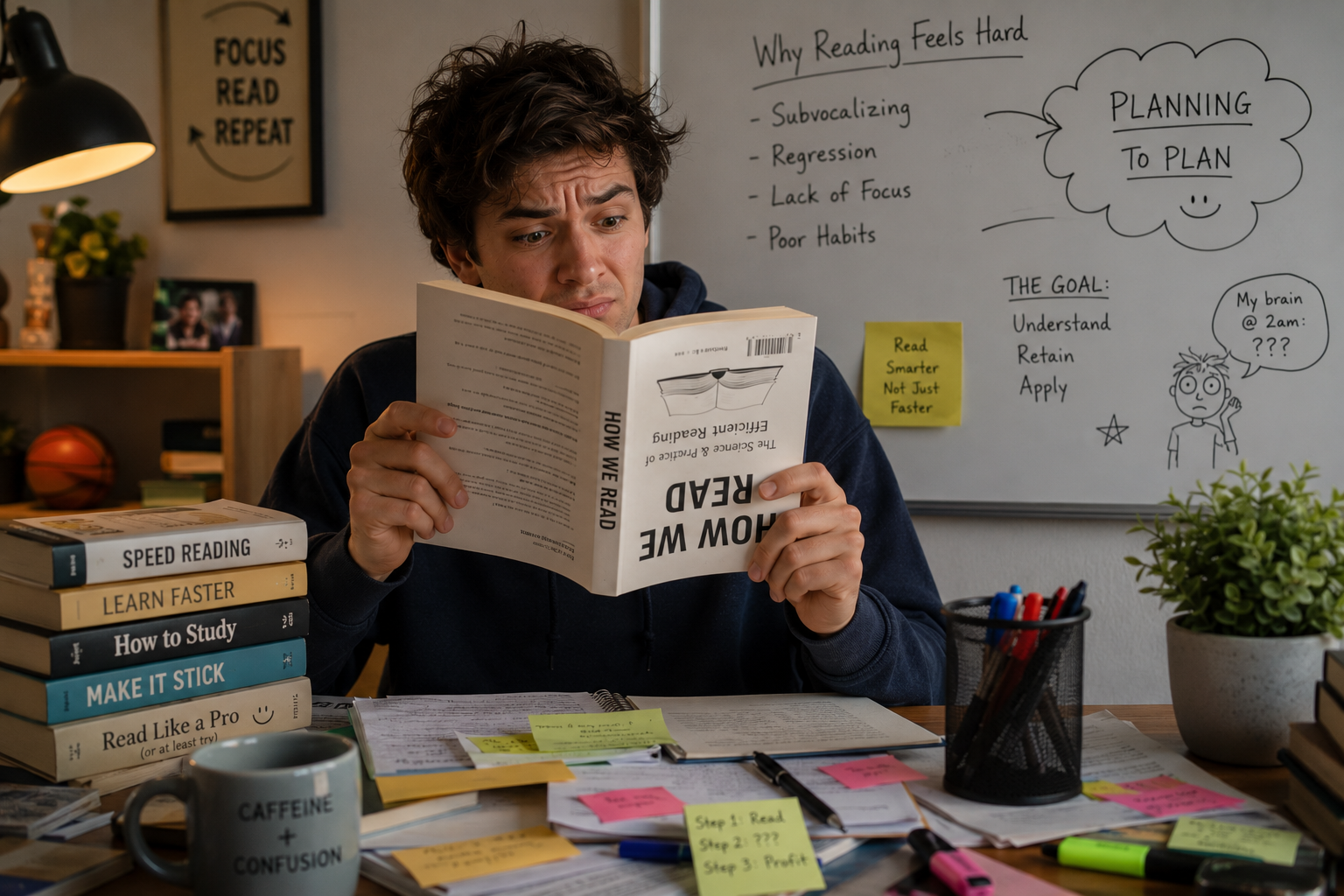
You were taught how to read a sentence.
You may never have been taught what to do when thirty pages arrive before a meeting, when only one section of a report matters, or when a document must be understood differently from an email, textbook, contract, or novel.
So you use the safest method you know: begin at the first word, read every line, and keep going until the document ends.
Most people learn how to recognise words, understand text, and answer questions. Far fewer receive explicit training in how to define a reading purpose, map a document, change pace, allocate attention, and decide when enough has been read.
The problem may not be your intelligence or effort.
You may be using one reading method for tasks that require several.
The Missing Skill Is Not Reading. It Is Control.
The title is deliberately blunt.
There is no single education system shared by everyone, and many teachers do teach previewing, summarising, questioning, and critical reading. The issue is not that schools teach reading badly.
The issue is that adult reading often demands a different layer of control.
Formal reading instruction understandably focuses on foundations such as:
- recognising words accurately
- developing fluency
- building vocabulary
- understanding sentences
- connecting ideas
- interpreting and evaluating text
Modern reading frameworks also recognise the importance of knowledge, motivation, executive function, purpose, and strategy. An Institute of Education Sciences overview of reading models describes skilled reading as the coordination of word recognition and language comprehension with broader cognitive and self-regulatory processes.
Those foundations make reading possible.
Adult life then adds another problem:
How should you use that ability when the amount of text is larger, the purpose is unclear, and not every section deserves equal attention?
That question is rarely answered by simply reading more carefully.
Adult Reading Is Not One Task
A workplace document may need to be:
- searched for one number
- skimmed for relevance
- read for its main recommendation
- checked for risk
- studied for later recall
- compared with another source
- followed as a precise set of instructions
Those are different tasks wearing the same costume: words on a page.
Yet many readers approach all of them in roughly the same way:
- Start at the beginning.
- Read every paragraph.
- Give each section similar attention.
- Reread whenever confidence drops.
- Stop only when the document ends.
That method feels responsible because nothing was deliberately skipped.
It can also waste enormous amounts of attention.
A twelve-page report may contain one page of conclusions, three pages of useful evidence, and eight pages of background that you already understand.
The page does not deserve equal attention merely because the author gave every paragraph the same font.
Efficient Reading Is Not Speed Reading
Efficient reading is often confused with permanent acceleration.
It does not mean:
- forcing your eyes to move faster
- eliminating every regression
- suppressing all inner speech
- skipping material indiscriminately
- absorbing entire pages through peripheral vision
- sacrificing understanding for a larger words-per-minute number
A major review of speed-reading research concluded that dramatic increases in pace usually involve a trade-off with comprehension. Readers are unlikely to double or triple their normal speed while preserving the same depth of understanding.
Efficient reading means something more practical:
Obtaining the result the task requires without spending unnecessary time and attention on material that does not require it.
Sometimes efficiency means moving faster.
Occasionally it means slowing down before an important mistake is made.
Sometimes it means closing the document after page four because the remaining sixteen pages cannot help you.
Speed is one tool. Selection is another.
Skilled Readers Change Their Behaviour With the Task
Efficient readers do not use one magical pace.
They adapt.
An eye-tracking study comparing regular reading, thorough reading, skimming, and proofreading found that the task changed how people moved through text.
When skimming, readers:
- finished more quickly
- skipped more words
- made longer eye movements
- retained less detailed information
When reading thoroughly, they:
- spent more time
- reread more
- achieved stronger comprehension
Neither pattern was universally better.
Each was suited to a different outcome.
Another eye-movement study of reading and proofreading found that readers adjusted how they processed words according to what the task required.
That is the central skill most people need:
not one faster method, but the ability to choose and change methods deliberately.
Five Decisions Make Reading More Efficient
Before and during a serious reading task, make five decisions.
1. Decide What the Text Must Give You
Do not begin with:
I need to read this.
That is an activity, not an outcome.
Finish this sentence instead:
When I stop reading, I need to know, decide, find, or do ________.
Examples:
- identify the main recommendation
- understand how the process works
- find the assumptions behind the forecast
- evaluate whether the evidence is credible
- learn the three concepts required for the exam
- locate the clause that affects the agreement
Purpose determines what deserves attention.
Without a purpose, every paragraph looks equally important and every uncertainty invites rereading.
Research on adult literacy has emphasised the importance of metacognitive control: choosing a strategy, monitoring whether it is working, and changing it when necessary. The review of adult reading-comprehension strategies identified summarising, drawing inferences, questioning, and self-regulation as important parts of effective adult comprehension.
The efficient reader is not merely processing text.
The efficient reader is managing a task.
2. Map the Document Before Reading It Closely
Spend thirty to sixty seconds inspecting the document.
Look at:
- the title
- headings
- introduction
- conclusion
- tables and diagrams
- highlighted terms
- section summaries
- repeated concepts
Ask:
- What is the document trying to do?
- How is it organised?
- Where is the likely answer?
- Which sections relate to my purpose?
- Which parts appear technical or unfamiliar?
- Is this source worth reading closely?
Previewing creates a map.
It does not replace reading any more than looking at a route replaces travelling. It simply stops you from exploring every side street with equal enthusiasm.
3. Choose the Appropriate Reading Mode
Use the purpose and map to select a mode.
Search
Use search when you need one fact, term, name, figure, or clause.
You are not trying to understand the entire argument.
Skim
Skim when you need:
- the broad topic
- the overall structure
- the main conclusion
- a decision about whether deeper reading is worthwhile
Skimming is faster because it deliberately accepts less detail.
Read normally
Use normal reading when you need to:
- follow the main argument
- understand a straightforward explanation
- learn moderately familiar material
- enjoy a narrative
Read closely
Read closely when:
- wording must be precise
- evidence must be evaluated
- instructions must be followed accurately
- concepts are unfamiliar
- qualifications affect the conclusion
- long-term retention matters
The mistake is not choosing the “wrong” mode in some absolute sense.
It is expecting a light skim to produce detailed understanding, or using close reading where a thirty-second search would have solved the task.
4. Allocate Attention Unevenly
Not every part of a document carries equal value.
Move faster through:
- familiar background
- repeated explanations
- predictable examples
- transitions
- sections unrelated to your purpose
Slow down for:
- definitions
- evidence
- changes in argument
- limitations
- unfamiliar terminology
- instructions
- conclusions that affect a decision
Prior knowledge influences how much processing a section requires. Research on prior knowledge and comprehension found that knowledge of the topic can support word identification and the construction of meaning.
That is why an experienced analyst can move rapidly through a familiar financial report while an intelligent beginner needs more time.
The expert is not necessarily moving their eyes better.
They already know which information matters and where it fits.
Efficient reading becomes easier as subject knowledge grows.
5. Retrieve the Result and Know When to Stop
Finishing the final sentence is not the same as completing the task.
After an important section, look away and state:
- the main point
- the evidence or reasoning supporting it
- the decision or action required
- what remains uncertain
This gives you a better test than:
Did I read every word?
Ask:
Can I use what I just read?
If the answer is yes and the original purpose has been met, continuing may provide little additional value.
Knowing when to stop is part of reading efficiently.
Finishing every document is not discipline if the document stopped being useful ten pages ago.
Why Inefficient Methods Survive
Once reading becomes automatic, the process becomes difficult to notice.
You focus on the document, not on how you are approaching it.
Several habits can continue for years:
- reading everything from beginning to end
- using one pace for all material
- treating time spent as proof of depth
- rereading whenever uncertainty appears
- highlighting without organising meaning
- giving every sentence equal importance
- continuing after the reading purpose has been fulfilled
These habits can work reasonably well when:
- the assignment is short
- the teacher has selected the text
- the purpose is already defined
- questions specify what matters
- the reader is expected to complete the whole piece
Adult reading is often less structured.
No one tells you which report deserves forty minutes, which needs five, and which should have remained unopened.
You must supply that judgment yourself.
Reading Mechanics Still Matter
Strategy does not make eye movements irrelevant.
During normal reading, the eyes alternate between short pauses called fixations and rapid movements called saccades. Readers also move backward when they need to correct positioning or repair meaning.
Too many unnecessary stops and regressions can make reading feel heavy.
But eye movements also respond to language difficulty. A rare word, complicated sentence, or unexpected claim may naturally require more processing.
That is why commanding the eyes to “stop less” is not a complete method.
Better mechanics must work alongside:
- vocabulary
- attention
- reading purpose
- prior knowledge
- comprehension monitoring
- flexible pace
The later article Reading Fixations: The Hidden Reason Your Pace Feels Heavy will examine this in detail.
For now, keep one rule:
Do not train movement without training judgment.
A Practical Method for Your Next Long Document
Use this sequence the next time you receive a report, article, or chapter.
Step 1: Write the outcome
One sentence:
I need this document to help me ________.
Step 2: Preview for one minute
Inspect the title, headings, opening, conclusion, visuals, and repeated terms.
Step 3: Mark three levels
Decide which sections deserve:
- high attention
- normal attention
- little or no attention
Step 4: Read in layers
First understand the overall argument.
Then return to the sections that require precision, learning, or evaluation.
Do not demand full detail before you understand the structure.
Step 5: Close and retrieve
Without looking, state the result.
Then reopen only what remains unclear.
This approach is especially useful for reports and educational material because it separates orientation from depth.
The full method for highly technical texts will be explored in How to Read Dense Information Without Constantly Restarting.
What Efficient Reading Does Not Mean
Efficiency is not an excuse to rush material that deserves care.
Do not skim:
- safety instructions you must perform correctly
- legal wording that affects a decision
- evidence you are responsible for evaluating
- unfamiliar medical or technical guidance
- material that must be remembered accurately
Efficiency also does not mean treating literature only as information extraction.
A novel, essay, or poem may be read for language, atmosphere, emotional experience, or reflection. In that context, slowing down may be the point rather than a defect.
The method should serve the text and the reader’s purpose.
The text should not be forced into a productivity system merely because a stopwatch is nearby.
Explore Read Fast Now for a structured approach to reading purpose, pace, comprehension, and mechanics.
When Strategy Is Not the Whole Answer
Reading strategies cannot explain every difficulty.
Qualified support may be appropriate when:
- reading has always required unusual effort
- ordinary material remains difficult despite good conditions
- you frequently lose lines or skip text
- reading significantly affects education or work
- visual discomfort or double vision accompanies reading
- attention difficulties affect several areas of life
- reading ability has noticeably or suddenly declined
Depending on the pattern, useful support may come from a reading specialist, educational psychologist, eye-care professional, or medical professional.
Read Fast Now supports reading habits and mechanics. It does not diagnose or treat dyslexia, ADHD, visual disorders, language-processing conditions, or neurological problems.
Efficient Reading Is a Form of Control
Most adults do not need a more aggressive relationship with text.
They need a more deliberate one.
Efficient reading means controlling:
- why you are reading
- what deserves attention
- how deeply each section should be processed
- when pace should change
- when rereading is necessary
- what needs to remain afterward
- when the task is complete
MindTecton treats reading as part of a wider system involving focus, memory, vision, and daily rhythm.
The goal is not to race through more pages.
It is to spend less effort on unnecessary processing so that more attention remains for meaning.
Final Takeaway
Most people learn the foundations required to read successfully.
They may receive far less explicit training in how to manage the uneven, purpose-driven reading demands of adult life.
Efficient readers do not simply move faster.
They:
- define the outcome
- map the document
- choose a mode
- allocate attention unevenly
- retrieve the result
- stop when the task is complete
You already know how to read.
The next level is learning how to direct the process.
Find the Layer Creating the Most Friction
Inefficient reading may involve pace, attention, comprehension, memory, visual comfort, or the structure of the task itself.
Take the MindTecton Assessment to identify which layer is currently limiting how efficiently you work, learn, read, remember, and perform.
Sources
- Regional Educational Laboratory Northwest, Institute of Education Sciences. Reading Instructional Practices and Models.
https://ies.ed.gov/sites/default/files/migrated/rel/regions/northwest/pdf/RELNW_MT-OPI-ELA_Brief-1_Reading-Inst-Practices-and-Models.pdf - Rayner K, Schotter ER, Masson MEJ, Potter MC, Treiman R. So Much to Read, So Little Time: How Do We Read, and Can Speed Reading Help? Psychological Science in the Public Interest. 2016.
https://pubmed.ncbi.nlm.nih.gov/26769745/ - Štrukelj A, Niehorster DC. One Page of Text: Eye Movements During Regular and Thorough Reading, Skimming, and Spell Checking. Journal of Eye Movement Research. 2018.
https://pmc.ncbi.nlm.nih.gov/articles/PMC7198234/ - Schotter ER, Bicknell K, Howard I, Levy R, Rayner K. Task Effects Reveal Cognitive Flexibility Responding to Frequency and Predictability: Evidence From Eye Movements in Reading and Proofreading. Cognition. 2014.
https://pubmed.ncbi.nlm.nih.gov/24434024/ - Hock MF, Mellard DF. Reading Comprehension Strategies for Adult Literacy Outcomes. Journal of Adolescent & Adult Literacy. 2005.
https://pmc.ncbi.nlm.nih.gov/articles/PMC3474365/ - Hock MF, Mellard DF. Efficacy of Learning Strategies Instruction in Adult Basic Education. Journal of Research on Educational Effectiveness. 2011.
https://pmc.ncbi.nlm.nih.gov/articles/PMC3223022/ - Priebe SJ, Keenan JM, Miller AC. How Prior Knowledge Affects Word Identification and Comprehension. Reading and Writing. 2011.
https://pmc.ncbi.nlm.nih.gov/articles/PMC3142886/