
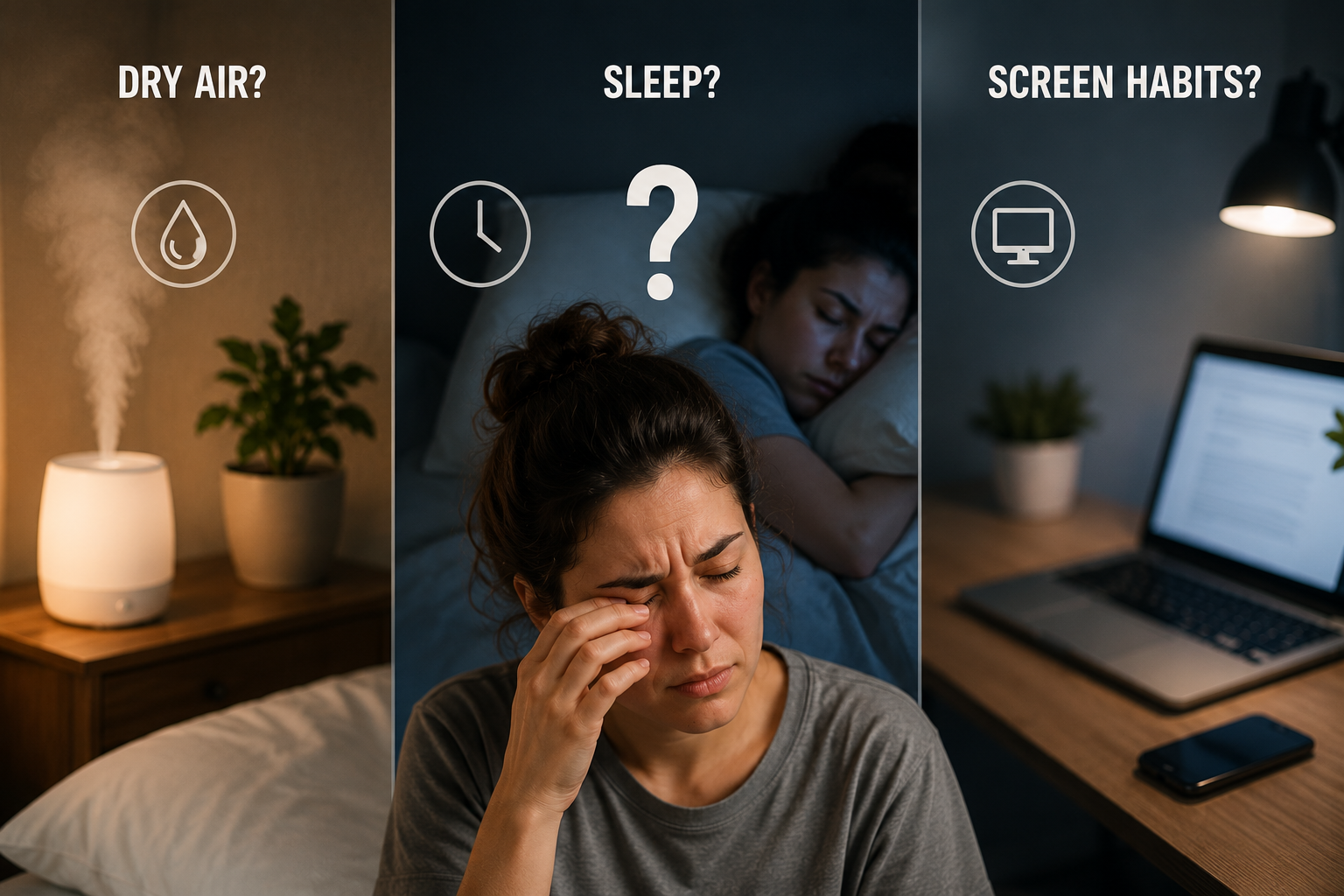
You wake up and immediately want to rub your eyes.
They may feel itchy, gritty, watery, heavy, or slightly irritated. After blinking, washing your face, or moving around for a while, the discomfort begins to settle.
Late screen use is an easy suspect. It may contribute, but the timing points somewhere else first.
Morning eye irritation is often shaped by what happened overnight. Dry bedroom air, direct airflow, and an already unstable tear film can leave the eyes uncomfortable on waking. Late screens and poor sleep may increase the problem, but they are usually contributors rather than the complete explanation.
The useful question is not only what you looked at before bed.
It is what conditions your eyes spent several hours recovering in.
Why the Morning Timing Matters
During the day, blinking regularly spreads tears across the front surface of the eyes.
While you sleep:
- blinking stops
- the eyelids remain closed for hours
- bedroom air continues circulating
- the eye surface depends on the protection provided by the eyelids and tear film
If the eyes were already dry or irritated before bed, the overnight environment can influence how they feel the next morning.
This is why symptoms that are strongest immediately after waking often deserve a different explanation from discomfort that appears only after several hours of screen work.
Morning symptoms point toward recovery conditions.
Dry Air and Airflow Can Increase Overnight Irritation
Heating, air conditioning, low humidity, and fans can increase tear evaporation.
The National Eye Institute’s guidance on dry eye recommends avoiding direct air movement toward the eyes and using a humidifier when indoor air is excessively dry.
Dry air is more likely to be contributing when:
- symptoms are worse during heating or air-conditioning season
- a fan or vent points toward the bed
- the eyes feel gritty or burning
- the nose or mouth also feels dry
- discomfort improves after several complete blinks
- symptoms vary between bedrooms, hotels, or seasons
The simplest first step is not buying another device.
Check the airflow.
Ask:
- Is a fan blowing toward the pillow?
- Is the bed directly beneath a vent?
- Is warm air circulating near your face?
- Does the room feel unusually dry overnight?
Redirecting the airflow may help more than placing a humidifier beside a vent that continues blowing across the eyes.
A humidifier may be useful when the room is genuinely dry, but it must be cleaned properly. Adding contaminated mist to irritated eyes would be an ambitious misunderstanding of the assignment.
Where Late Screens Fit
Screen use can leave the eyes less comfortable before sleep.
During concentrated device use, people may blink less often or incompletely. A review of digital screen use and dry-eye disease links prolonged screen use with altered blinking and tear-film disturbance.
Late screen habits may contribute by:
- extending close visual work
- leaving the eyes dry before bed
- encouraging prolonged contact-lens wear
- delaying bedtime
- reducing sleep duration
That can make the overnight recovery period begin under worse conditions.
But screen use does not explain every case of morning itching.
If the eyes feel worst immediately after waking and then improve, the sleeping environment and overnight eye-surface conditions may matter more than the phone itself.
Night mode changes the display colour.
It does not blink for you, redirect the fan, or return the hour lost to scrolling.
Poor Sleep Can Make Existing Discomfort Feel Worse
Sleep and dry-eye symptoms are associated, although the relationship is not a simple one-way cause.
A 2024 systematic review and meta-analysis found that people with dry-eye disease tended to report poorer sleep quality and less healthy sleep duration.
This does not mean one short night directly creates dry-eye disease.
Poor sleep may instead:
- increase fatigue
- make irritation harder to tolerate
- increase headache or light sensitivity
- reduce recovery from the previous day’s visual load
Eye discomfort can also interfere with sleep, so the relationship may work in both directions.
The practical conclusion is modest:
Poor sleep can amplify morning discomfort, even when it is not the original cause.
What About True Itching?
Strong itching deserves a little caution.
Dryness more often causes:
- burning
- grittiness
- scratchiness
- fluctuating clarity
Allergy more often causes:
- strong itching
- watering
- puffy eyelids
- redness in both eyes
- seasonal symptoms
- sneezing or nasal congestion
The American Academy of Ophthalmology identifies itching as a common feature of eye allergy.
That does not mean every itchy morning is an allergy.
It means persistent, intense itching should not automatically be blamed on screens or dry air.
The article’s main point still holds: the morning timing directs attention toward what happened overnight. Allergy, bedding, dust, pollen, and bedroom air may all be more relevant than the final fifteen minutes spent looking at a phone.
What Can You Change Tonight?
Redirect airflow
Move fans or vents away from the face.
This is the fastest and most overlooked adjustment.
End close screen use earlier
Reducing late phone or laptop use may leave the tear film in a better condition before sleep and protect bedtime.
The goal is not perfect digital purity.
It is avoiding another hour of small-text staring when the eyes are already tired.
Finish contact-lens wear on time
Do not extend lens wear because the evening ran longer than planned.
Never sleep in contact lenses unless they were specifically prescribed for overnight use.
Keep the bedroom environment clean
Wash pillowcases and bedding regularly, especially when allergy is possible.
Reduce visible dust near the bed and avoid letting pets sleep directly on the pillow if symptoms repeatedly occur.
Use a cool compress instead of rubbing
Place a clean, cool compress over closed eyelids for several minutes.
Rubbing may provide a few seconds of relief while creating more redness and irritation afterward.
Track the pattern briefly
For several mornings, note:
- whether both eyes are affected
- whether the main sensation is itch, burning, or grittiness
- bedroom airflow
- heating or air-conditioning use
- bedtime
- late screen use
- contact-lens wear
- allergy symptoms
You are looking for repetition, not building a forensic investigation around your pillowcase.
A Simple Way to Interpret the Pattern
If symptoms improve after blinking and are worse with fans, heating, or air conditioning, overnight dryness may be contributing.
Strong itching, watering, puffiness, or nasal allergy symptoms occur, allergy becomes more likely.
If symptoms follow late screens and short sleep, accumulated dryness and poor recovery may be amplifying the problem.
More than one factor can be present.
The goal is not to diagnose yourself from one morning. It is to stop treating screen use as the automatic explanation for every symptom that appears near a device.
When Morning Eye Irritation Needs Checking
Arrange an eye examination when:
- symptoms repeatedly return
- one eye is consistently worse
- irritation lasts well into the day
- vision remains blurred
- contact lenses have become uncomfortable
- strong itching or swelling persists
- crusting or unusual discharge appears
- simple environmental changes do not help
Seek prompt medical assessment for:
- significant eye pain
- marked redness
- sensitivity to light
- persistent blurry vision
- thick discharge
- swelling around one eye
- symptoms after an injury
- redness, pain, or blur in a contact-lens wearer
Morning irritation is often manageable.
It should not become a permanent label placed over a recurring eye problem without proper evaluation.
Explore See Clarity Now for a structured approach to visual habits, screen use, comfort, and recovery.
The program supports better habits and working conditions. It does not diagnose allergy, dry-eye disease, infection, or other eye conditions, and it does not replace an eye examination or medical care.
Final Takeaway
Morning itchy or irritated eyes are not automatically caused by late screen use.
The overnight environment often matters more directly.
Dry air and airflow can increase eye-surface discomfort while you sleep. Late screens may leave the eyes drier before bed, and poor sleep may make the irritation feel heavier the next morning.
Start with the conditions surrounding sleep:
- move airflow away from the face
- reduce excessive late screen use
- protect sleep
- finish contact-lens wear on time
- avoid rubbing
- notice whether allergy symptoms are present
Do not simply blame the final screen you used.
Pay attention to the several hours that followed it.
Find the Layer Creating the Most Friction
Morning eye discomfort may involve overnight dryness, screen habits, sleep rhythm, allergy, or several layers working together.
Take the MindTecton Assessment to identify which layer is currently limiting how efficiently you work, learn, read, remember, and perform.
Sources
- National Eye Institute. Dry Eye.
https://www.nei.nih.gov/eye-health-information/eye-conditions-and-diseases/dry-eye - American Academy of Ophthalmology. Eye Allergies: Why Are My Eyes Itchy?
https://www.aao.org/eye-health/diseases/allergies - Al-Mohtaseb Z, et al. The Relationship Between Dry Eye Disease and Digital Screen Use. Clinical Ophthalmology. 2021.
https://pmc.ncbi.nlm.nih.gov/articles/PMC8439964/ - Gu Y, et al. Association Between Sleep Quality and Dry Eye Disease: A Systematic Review and Meta-Analysis. BMC Ophthalmology. 2024.
https://pmc.ncbi.nlm.nih.gov/articles/PMC10996221/