
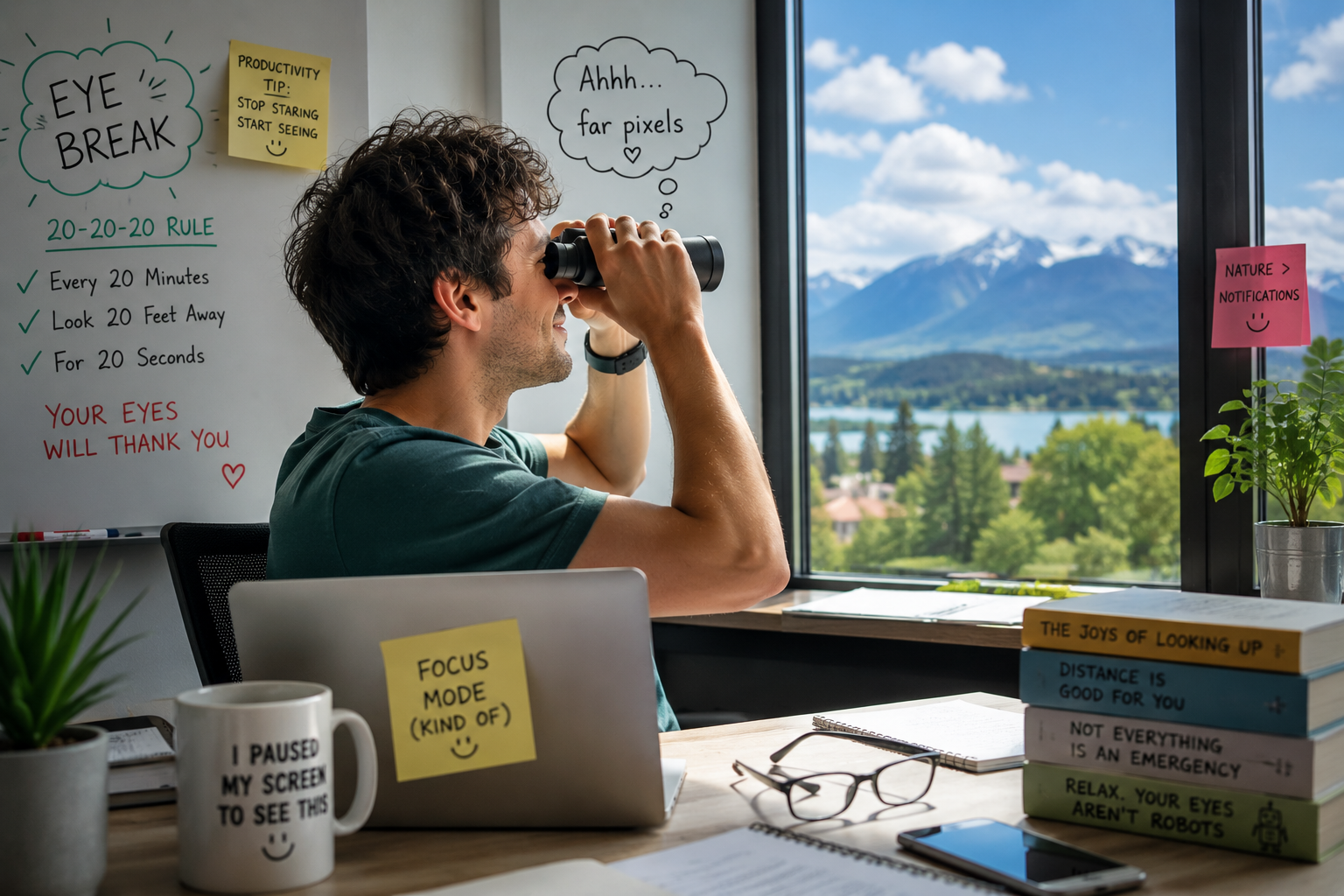
After a long stretch of reading or screen work, you look across the room and the distance does not immediately appear crisp. Your eyes may feel slow to refocus, heavy behind the brow, or reluctant to leave the near task.
Looking into the distance can help—but not because it “strengthens” the eyes or repairs your prescription.
Distance viewing reduces the focusing and eye-alignment demand required for close work. It gives the accommodative and vergence systems a different task, allows temporary near-focus after-effects to clear, and interrupts a long period of fixed visual attention.
That makes it useful after sustained near work.
It does not reverse myopia, cure dry eye, or replace an eye examination when focusing problems persist.
What Changes When You Look at Something Near?
To keep a close object clear and single, the visual system must coordinate several responses.
Accommodation changes optical focus
Accommodation changes the shape and optical power of the eye’s natural lens so that a near target remains clear.
The amount of accommodative demand rises as the viewing distance becomes shorter.
A target at:
- 1 metre requires roughly 1 dioptre of accommodation
- 50 centimetres requires roughly 2 dioptres
- 40 centimetres requires roughly 2.5 dioptres
- 33 centimetres requires roughly 3 dioptres
A distant target—around six metres or farther—requires very little accommodation by comparison.
This does not mean near work is harmful merely because the number is higher. The visual system is designed to change focus.
The problem is repetition: holding approximately the same response for long periods with little variation.
Vergence keeps the two eyes aligned
When you look at something close, both eyes rotate inward so that they remain directed toward the same target.
This inward alignment is called convergence, one part of the wider vergence system.
As the target moves farther away, the eyes need less convergence.
Accommodation and vergence are neurologically linked, although they are not identical. Prolonged near work therefore involves more than “using the focusing muscle.” The system must maintain optical clarity and binocular alignment together.
Looking into the distance changes both demands.
Why Distance Can Look Blurry After Near Work
Some people experience a short period of softer distance vision immediately after sustained close work.
One possible mechanism is near-work-induced transient myopia, usually shortened to NITM.
NITM is a temporary shift toward nearsighted focus after near work. In practical terms, the focusing response does not immediately return to its distance state when the target changes.
A critical review of near-work-induced transient myopia describes the effect as a short-lived accommodative after-effect that gradually decays after the near task ends.
The shift is generally small and varies considerably between people.
That distinction matters:
- NITM is temporary.
- It is not identical to permanent myopia.
- It does not explain every case of blur after screen use.
- Experiencing it does not prove that your prescription has changed.
A study of college students with visual discomfort found measurable transient focusing changes after near work, but not every participant responded in the same way.
Distance blur after screens can also involve:
- unstable tears
- incomplete blinking
- an outdated prescription
- dry-eye symptoms
- accommodative dysfunction
- binocular-vision difficulty
- fatigue
- poor viewing conditions
Distance viewing helps one plausible part of the system. It should not be used as a home diagnosis.
Why Looking Far Away Helps
Looking farther away reduces near accommodative demand and the amount of convergence required to keep the target single.
That gives the visual system an opportunity to shift away from the response it has been maintaining.
The benefit is not that the eyes become inactive.
They are still seeing. They are simply operating under a different demand.
This can help when the main symptom is:
- temporary distance softness after near work
- difficulty changing focus from near to far
- aching associated with sustained close tasks
- a sense that focus has become “stuck”
- discomfort that increases during uninterrupted near work
A 2023 study measuring accommodative facility after computer tasks found that one hour of computer work reduced near accommodative facility and delayed part of the focusing response in young adults.
One study does not establish a universal mechanism, but it supports the practical observation that prolonged computer work can temporarily affect how efficiently focus changes.
Distance viewing gives that system a reason to change state.
Distance Viewing Is Not the Same as Closing Your Eyes
Closing your eyes can be restful.
It removes the visual target, reduces light input, and may support more complete blinking or tear redistribution when the eyes reopen.
But it does not actively require the focusing and vergence systems to settle onto a different viewing distance.
Looking at a distant object does.
That makes the two breaks related but not interchangeable.
A useful visual break may combine both:
- look away from the near task
- blink naturally several times
- settle your gaze on a distant target
- change posture or stand up
The point is not to perform an eye exercise with military precision.
It is to stop repeating the same near response.
How Far Is “Far Enough”?
The common recommendation is to look at something approximately 20 feet, or six metres, away.
At that distance, accommodative demand is very low compared with ordinary reading distance.
You do not need a tape measure.
A target outside a window, across a large room, or down a corridor is usually sufficient.
Looking from:
- a phone at 25 centimetres
- to a laptop at 50 centimetres
does change demand, but both remain near or intermediate tasks.
Looking toward a distant building or tree creates a larger change.
The practical question is:
Is this target meaningfully farther away than the work I was just doing?
Switching from a spreadsheet to social media on a phone fails that test with impressive efficiency.
Does the 20-20-20 Rule Have Strong Evidence?
The 20-20-20 rule recommends:
- every 20 minutes
- look at something 20 feet away
- for 20 seconds
The American Optometric Association and the American Academy of Ophthalmology both recommend regular distance breaks as a practical response to prolonged screen work.
The principle is reasonable.
The exact numbers are less certain.
The rule was designed to be memorable, not discovered as a precise biological threshold. A visual system does not collapse at minute 21 because someone missed the approved window.
More recent research adds useful nuance.
A 2025 experimental study of break schedules compared four conditions during a 40-minute reading task:
- no break
- one break after 20 minutes
- breaks every 10 minutes
- self-paced breaks
The 24 young adults reported more irritation and eye strain without breaks than with frequent or self-paced breaks. Near-work-induced transient myopia was also lower with frequent and self-paced breaks, and its recovery was faster in the frequent-break condition.
The single break after 20 minutes did not clearly outperform the more frequent or individualized schedules.
This does not invalidate the 20-20-20 rule. The study was small, short, and limited to young adults.
It suggests something more useful than blind loyalty to the slogan:
Break frequency may need to match the task and the individual.
For demanding close work, shorter and more frequent pauses—or pauses taken when early strain appears—may work better than waiting for one fixed interval.
Which Symptoms Are Most Likely to Respond?
Distance viewing is more likely to help symptoms related to sustained near-focus demand.
These may include:
- distance blur immediately after close work
- slow near-to-far refocusing
- aching behind or around the eyes
- headaches associated with sustained near tasks
- discomfort that improves when the viewing distance changes
It may help dry or burning eyes indirectly because stopping the task can restore more natural blinking.
But if the main symptoms are:
- burning
- grittiness
- redness
- watering
- brief clarity improvement after blinking
the ocular surface may be playing a larger role.
In that case, distance viewing alone may not address the main cause. Blinking, airflow, humidity, contact-lens use, and dry-eye evaluation may matter more.
This is why “eye strain” should not be treated as one mechanism with one solution.
A Better Distance-Break Method
There is no proven perfect dose, but a useful break can be more deliberate than glancing away for two seconds while still mentally wrestling the spreadsheet.
Choose a genuinely distant target
Use the farthest comfortable view available—ideally around six metres or more.
Let the target become clear without squinting or forcing.
Give focus time to settle
Stay with the distant view for at least 20 seconds.
If your distance vision initially feels soft, allow it to clear naturally rather than repeatedly testing whether it is sharp yet.
A longer break may be sensible after an extended near-work block.
Shift between several distant details
Look naturally at a building, tree, sign, horizon, or objects at different far distances.
Do not stare rigidly at one point.
This is visual variation, not a concentration contest.
Blink normally
Use several slow, complete blinks.
This helps separate a focusing-related symptom from blur caused partly by tear instability.
Change body position
Sit back or stand.
Release the jaw, lower the shoulders, and move away from the posture used during near work.
The focusing system does not operate in a vacuum attached to a neckless human.
Return before symptoms become strong
Use natural boundaries:
- after a paragraph or section
- between tasks
- after a meeting
- before changing to another screen activity
- when you notice leaning closer or squinting
Breaks are usually more useful before fatigue becomes severe.
What Distance Viewing Cannot Do
Looking far away does not:
- reverse myopia
- remove astigmatism
- permanently change refractive error
- eliminate the need for glasses
- cure dry-eye disease
- treat every accommodative disorder
- correct binocular-vision dysfunction
- compensate for an unsuitable prescription
It is also important not to confuse a brief distance break with time outdoors.
Outdoor time has been associated with a lower risk of developing myopia in children. That effect may involve bright outdoor light and reduced time spent on near tasks—not merely looking far away for twenty seconds.
A window break is useful for visual variation.
It is not an outdoor-myopia treatment compressed into office hours.
Why Distance Breaks Sometimes Fail
The focusing demand may improve while the main source of discomfort remains.
Symptoms may continue because:
- the tear film is unstable
- the text is too small
- glare is excessive
- airflow is drying the eyes
- contact lenses are uncomfortable
- the prescription is outdated
- sleep is poor
- posture remains strained
- the workday contains too little overall recovery
- an accommodative or binocular problem is present
This is why a person can follow the 20-20-20 rule and still feel tired.
The break may be useful but incomplete.
The wider limits of breaks will be covered in Why Screen Breaks Sometimes Don’t Fix Eye Fatigue.
When Slow Refocusing Needs Checking
Arrange an eye examination when:
- distance remains blurred after near work
- focusing changes are becoming frequent
- one eye consistently sees differently
- headaches repeatedly accompany reading
- you experience double vision
- words appear to move
- you need to close one eye during near tasks
- glasses no longer provide stable clarity
- symptoms interfere with school or work
An eye-care professional can assess refraction, accommodation, vergence, eye alignment, and the ocular surface.
Seek urgent assessment for sudden visual loss, severe pain, marked redness, sudden double vision, new flashes or many floaters, a curtain-like shadow, visual change after injury, or visual symptoms with neurological signs.
A brief near-to-distance transition can occur.
Persistent blur should not be managed by staring more ambitiously through a window.
Visual Variation Is Part of Better Work Rhythm
Near work is not the enemy.
The problem is allowing one visual demand to dominate hours of work without variation.
Distance breaks can reduce sustained accommodative and convergence demand, interrupt rigid attention, and create an opportunity for more natural blinking and posture.
Explore See Clarity Now for a structured approach to visual habits, comfort, recovery, and eye–brain performance.
The program supports better habits and working conditions. It does not reverse refractive error or replace prescription correction, diagnosis, an eye examination, or medical care.
Final Takeaway
Looking into the distance helps because near and far vision require different levels of accommodation and eye alignment.
After sustained near work, a distant target can:
- reduce accommodative demand
- reduce convergence demand
- allow temporary focusing after-effects to clear
- interrupt fixed visual attention
- support more natural blinking and posture
The 20-20-20 rule is a useful reminder, not a biologically perfect formula. Newer evidence suggests that more frequent or self-paced breaks may work better for some people and tasks.
Use distance viewing as visual variation—not as a cure.
Your eyes may not need strengthening.
They may need a different demand.
Find the Layer Creating the Most Friction
Difficulty recovering after near work may involve accommodation, eye coordination, dryness, posture, attention, or the rhythm of the workday.
Take the MindTecton Assessment to identify which layer is currently limiting how efficiently you work, learn, read, remember, and perform.
Sources
- Ong E, Ciuffreda KJ. Nearwork-Induced Transient Myopia: A Critical Review. Documenta Ophthalmologica. 1995.
https://pubmed.ncbi.nlm.nih.gov/8861637/ - Borsting E, Tosha C, Chase C, Ridder WH III. Measuring Near-Induced Transient Myopia in College Students With Visual Discomfort. Optometry and Vision Science. 2010.
https://pubmed.ncbi.nlm.nih.gov/20802366/ - Kaliugavaradhan A, et al. Accommodative Facility and Response Time Before and After Computer Tasks of Varying Durations in Young Adults. British and Irish Orthoptic Journal. 2023.
https://pubmed.ncbi.nlm.nih.gov/37868656/ - Redondo B, Jiménez R, Vera J, Rosenfield M. The Impact of Break Schedules on Digital Eye Strain Symptoms and Ocular Accommodation During Prolonged Near Work. Experimental Eye Research. 2025.
https://pubmed.ncbi.nlm.nih.gov/40466853/ - Pucker AD, et al. Digital Eye Strain: Updated Perspectives. Clinical Optometry. 2024.
https://pmc.ncbi.nlm.nih.gov/articles/PMC11416787/ - American Academy of Ophthalmology. Computers, Digital Devices, and Eye Strain.
https://www.aao.org/eye-health/tips-prevention/computer-usage - American Optometric Association. Computer Vision Syndrome.
https://www.aoa.org/healthy-eyes/eye-and-vision-conditions/computer-vision-syndrome