
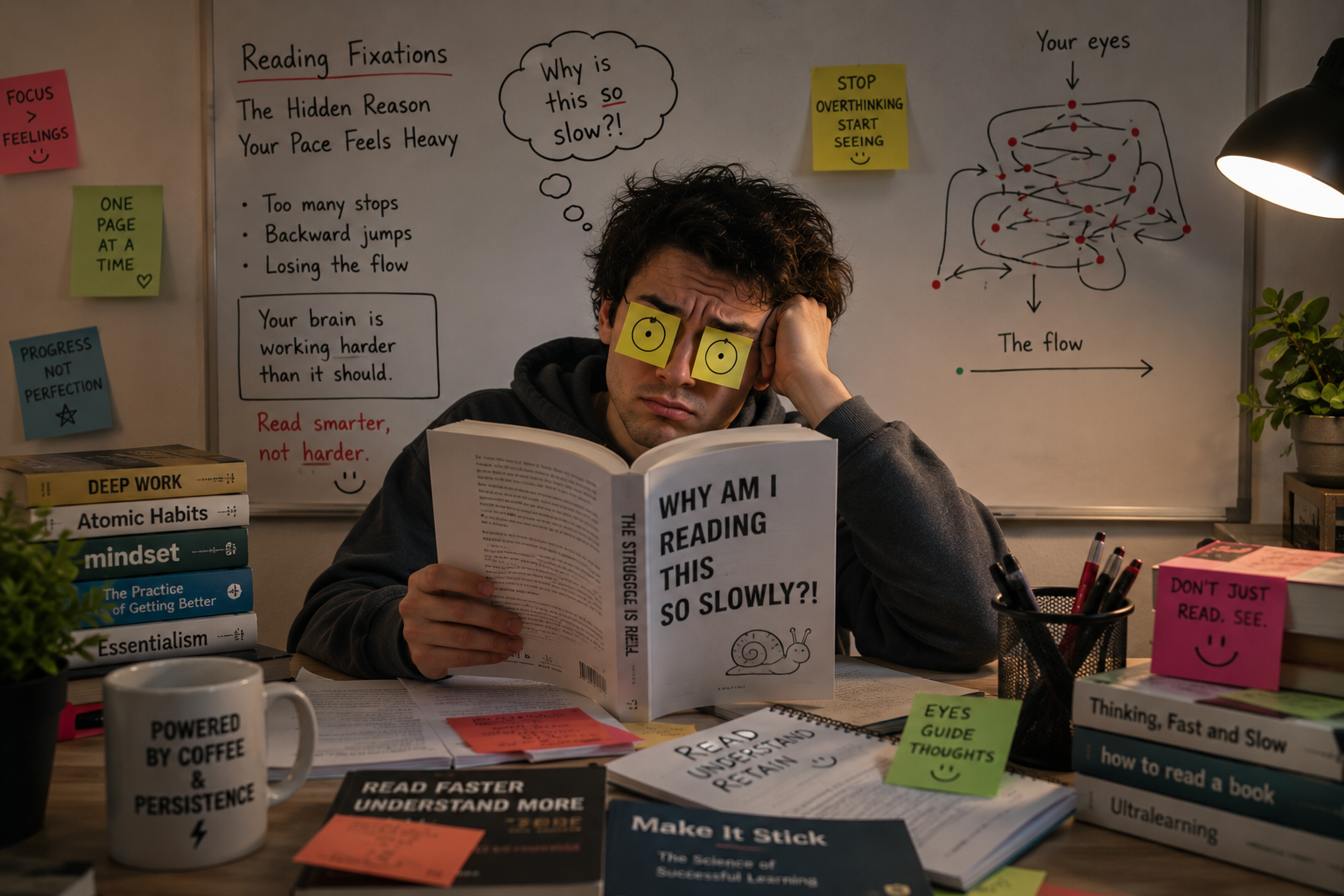
You recognise the words, but reading still feels slow.
Your eyes move across the line in short bursts. Every word seems to demand its own moment, sentences feel fragmented, and a page takes more effort than its difficulty should require.
The problem may not be your intelligence or even your ability to understand the material.
It may be the way your attention stops across the text.
Fixations are the brief pauses your eyes make while reading. They are necessary because this is when much of the visual and language processing occurs. Reading begins to feel heavy when those pauses become more frequent or longer than the material requires.
The goal is not to eliminate fixations.
It is to make the stopping pattern better match the text.
What Is a Reading Fixation?
Your eyes do not glide smoothly across a sentence.
They alternate between:
- fixations, when the gaze pauses briefly
- saccades, the quick movements that carry the eyes to the next position
These movements happen rapidly, so reading feels continuous even though it is built from a sequence of stops and jumps.
A major review of eye movements during reading explains that fixation patterns reflect the difficulty of the language being processed. Familiar and predictable words often receive less attention. Uncommon, important, or unexpected words tend to receive more.
That means fixations are not simply mechanical pauses.
They are closely connected to understanding.
Your eyes stop because the brain is identifying words, connecting them with the sentence, and deciding where attention should move next.
Fixations Are Necessary
Some speed-reading advice treats every stop as wasted time.
That is misleading.
Detailed visual information is gathered mainly while the eyes are relatively stable. If the eyes never paused, the page would not become effortlessly clear. Normal reading would simply become impossible.
Fixations allow you to:
- identify words
- access their meanings
- connect words into phrases
- follow sentence structure
- update the main idea
- notice important qualifications
The problem is therefore not that your eyes stop.
The problem is that they may stop more often than the language requires.
Why Word-by-Word Reading Feels Heavy
Consider this sentence:
The revised plan reduced costs without delaying the project.
A fragmented reader may process it like this:
The / revised / plan / reduced / costs / without / delaying / the / project.
Each word becomes a separate event.
A smoother reading pattern may feel closer to:
The revised plan / reduced costs / without delaying the project.
These slashes are only an illustration. Eye movements do not divide sentences into perfectly neat groups.
But the difference captures an important idea:
Meaning is usually carried by connected phrases, not isolated words.
When every word receives equal attention, the sentence becomes harder to hold together. The reader may understand each term but lose the rhythm and structure connecting them.
This creates the familiar experience of reading slowly while still feeling that the information is not settling.
Not Every Word Deserves the Same Amount of Attention
Skilled reading is uneven.
A term such as statistically significant, subject to approval, or except where prohibited may deserve careful attention because it changes the meaning.
Words such as the, of, and to usually require less deliberate processing.
Research on word frequency, predictability, and visual difficulty found that readers spent more time on words that were less common, less predictable, or harder to see.
That is exactly what an efficient system should do.
The reading pattern becomes inefficient when:
- short familiar words receive full attention
- simple phrases remain fragmented
- easy and difficult sections are read at one cautious pace
- the eyes repeatedly pause without gaining more meaning
A longer fixation on a new technical term may be appropriate.
A long fixation on every familiar word is more likely to be friction.
Why Fewer Fixations Are Not Always Better
It is tempting to assume that reducing the number of stops will automatically improve reading.
Not necessarily.
Fewer fixations may mean that the reader is:
- processing familiar text efficiently
- reading connected phrases
- using context well
But it may also mean that the reader is:
- skimming
- skipping useful information
- missing qualifications
- moving faster than comprehension allows
A major review of speed-reading research concluded that large increases in pace generally involve a trade-off with understanding.
You can always finish faster by processing less.
That is useful when you only need the broad topic. It is not useful when exact meaning matters.
The goal is not the fewest possible fixations.
It is the fewest unnecessary fixations while preserving the level of understanding the task requires.
What Makes a Fixation Pattern Inefficient?
Several habits commonly make reading feel more stop–start than necessary.
Treating every word as equally important
The reader gives full attention to function words, familiar phrases, and repeated information.
Nothing is prioritised, so the entire page feels equally heavy.
Using the same pace throughout
A familiar example is read as cautiously as a difficult definition.
The reading method does not adjust when the text becomes easier.
Restarting after minor uncertainty
A small moment of doubt causes the eyes to return even though the sentence may resolve itself by the end.
This adds extra stops and breaks the forward rhythm.
Reading without a clear purpose
When you do not know what you need from the text, every detail feels potentially important.
That encourages overprocessing.
Working with material that is too difficult
Unfamiliar vocabulary and weak background knowledge naturally increase fixation time.
In that case, forcing faster eye movement is not the solution. The material genuinely requires more processing.
Efficient reading begins by identifying which of these patterns is present.
Can You Feel Your Fixations?
You cannot measure exact fixation duration without eye-tracking equipment.
But you can notice how the reading process feels.
Possible signs of an overly fragmented pattern include:
- every word feels separately pronounced
- simple sentences feel mechanically slow
- your finger stops under nearly every word
- familiar phrases never develop momentum
- you repeatedly pause without knowing why
- your pace remains unchanged when the text becomes easy
- you finish sentences but struggle to hold the whole idea together
These signs do not prove that your eyes are moving incorrectly.
They suggest that attention may be divided into units smaller than the meaning requires.
What Efficient Fixations Feel Like
Efficient reading does not feel like flying across the page.
It feels controlled.
The pattern may include:
- lighter attention on predictable words
- stronger attention on key terms
- smoother movement through familiar phrases
- slower processing around definitions and evidence
- fewer automatic returns
- pace changes that follow difficulty
The eyes still stop.
They simply stop where the information earns the time.
How to Develop a Smoother Reading Rhythm
The goal is not to force wider jumps.
It is to create the language and attention conditions that make unnecessary stops less likely.
Read for connected phrases
Notice natural groups such as:
- the main cause
- according to the report
- after several attempts
- one important limitation
Do not try to force each phrase into one fixation.
Simply direct attention toward the phrase as a meaningful unit instead of mentally presenting each word separately.
Let familiar words receive lighter attention
When the wording is predictable, allow it to move more naturally.
Save deliberate attention for:
- important nouns and verbs
- contrasts
- qualifications
- unfamiliar terminology
- changes in the argument
Every supporting word does not require its own red-carpet arrival.
Preview before reading closely
Look at the title, headings, repeated terms, and general structure.
Previewing increases context.
When you know what kind of information is coming, familiar words and phrases are easier to process without excessive stopping.
Practise with manageable material
Choose text that is clear but not completely effortless.
Extremely technical writing produces longer pauses for legitimate reasons. It is difficult to practise rhythm when every second word needs investigation.
Build smoother reading on manageable material, then transfer the skill to denser texts.
Finish the sentence before going backward
When uncertainty appears, continue to the end unless meaning has completely collapsed.
The rest of the sentence may resolve the problem.
If it remains unclear, return to the specific phrase rather than restarting everything.
This keeps one small doubt from creating another full tour of the paragraph.
Use a visual guide as an experiment
Move a finger, pen, or cursor beneath the line at a steady, comfortable pace.
The guide can reveal:
- hesitation
- word-by-word stopping
- repeated backward movement
- unstable rhythm
It should support continuity, not drag your eyes past comprehension.
A guide is useful when it steadies the process. It is useless when it turns reading into a pursuit scene.
Check meaning after each section
Ask:
- What was the main point?
- Which detail mattered?
- What changed?
- Can I explain it without looking?
If the reading becomes smoother and comprehension remains strong, the adjustment is useful.
If comprehension drops, the new pace is too aggressive or the text requires more attention.
A Simple Fixation Practice
Choose two short nonfiction passages of similar difficulty.
First passage
Read normally.
Notice:
- whether every word feels separate
- where the rhythm slows
- which phrases receive extra attention
- whether you return without a clear reason
Second passage
Make three changes:
- preview the paragraph
- focus on connected phrases
- allow predictable words to receive lighter attention
Do not force large eye movements.
Then ask:
- Did the second passage feel less fragmented?
- Was the meaning still clear?
- Did you stop less on familiar words?
- Which terms still deserved more attention?
- Could you summarise the paragraph afterward?
The exercise does not measure fixations scientifically.
It trains the decision behind them: what deserves attention, and what can move more lightly.
What Not to Do
Avoid methods that ask you to:
- eliminate fixations
- absorb full lines in one glance
- force larger and larger eye jumps
- race a pointer regardless of meaning
- prevent every backward movement
- treat comprehension as secondary
Fixations exist because reading requires processing time.
A technique can make the stopwatch look better by removing that time. It cannot guarantee that the information survived the journey.
Explore Read Fast Now for a structured approach to reading pace, comprehension, fixations, and reading mechanics.
When the Problem May Not Be Fixations Alone
Consider qualified support when:
- reading has always required unusual effort
- ordinary text remains difficult despite practice
- you regularly skip or repeat lines
- visual discomfort or double vision accompanies reading
- reading significantly affects school or work
- reading ability has noticeably or suddenly declined
Depending on the pattern, support may come from a reading specialist, educational psychologist, eye-care professional, or medical professional.
Read Fast Now supports reading mechanics and habits. It does not diagnose or treat dyslexia, ADHD, visual disorders, language-processing conditions, or neurological problems.
Final Takeaway
Fixations are not flaws.
They are the brief stops that allow words and ideas to be processed.
Reading begins to feel heavy when familiar language receives more stops and more attention than it needs.
The solution is not to eliminate pauses.
It is to allocate them better.
Let familiar phrases move smoothly. Slow down when the meaning genuinely demands it. Judge progress by comprehension and control, not by how few times your eyes appear to stop.
Efficient reading is not movement without pauses.
It is making each pause earn its place.
Find the Layer Creating the Most Friction
A heavy reading pace may involve fixations, rereading, attention, vocabulary, visual comfort, or the purpose of the task.
Take the MindTecton Assessment to identify which layer is currently limiting how efficiently you work, learn, read, remember, and perform.
Sources
- Rayner K. Eye Movements in Reading and Information Processing: 20 Years of Research. Psychological Bulletin. 1998.
https://pubmed.ncbi.nlm.nih.gov/9849112/ - Rayner K, Reichle ED, Stroud MJ, Williams CC, Pollatsek A. The Effect of Word Frequency, Word Predictability, and Font Difficulty on Eye Movements During Reading. Psychology and Aging. 2006.
https://pubmed.ncbi.nlm.nih.gov/16953709/ - Ashby J, Rayner K, Clifton C Jr. Eye Movements of Highly Skilled and Average Readers: Differential Effects of Frequency and Predictability. Quarterly Journal of Experimental Psychology. 2005.
https://pubmed.ncbi.nlm.nih.gov/16194948/ - Rayner K, Schotter ER, Masson MEJ, Potter MC, Treiman R. So Much to Read, So Little Time: How Do We Read, and Can Speed Reading Help? Psychological Science in the Public Interest. 2016.
https://pubmed.ncbi.nlm.nih.gov/26769745/