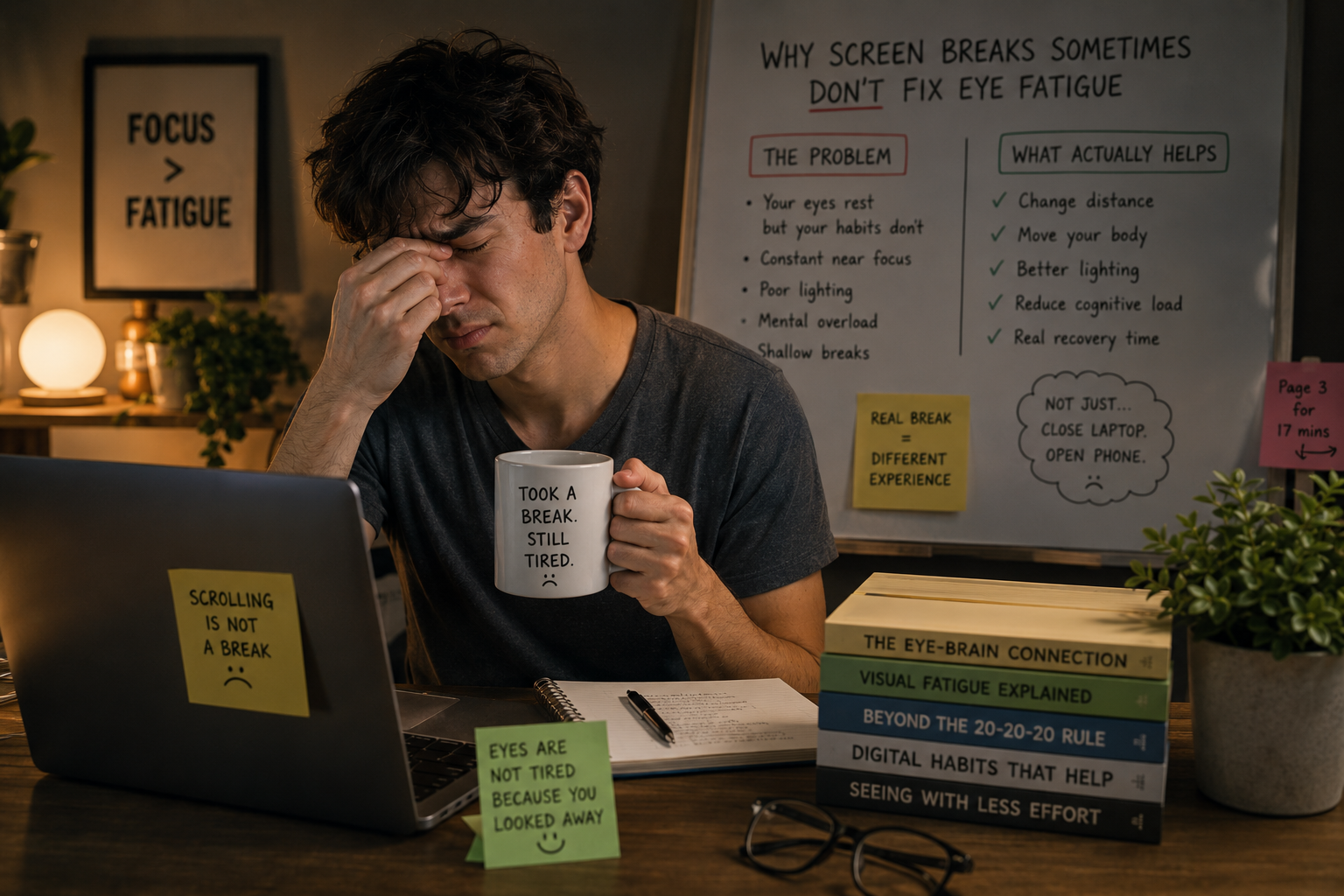
You follow the standard advice. You look away from the screen, focus on something distant for twenty seconds, and return to work.
Your eyes still feel tired.
That does not mean screen breaks are useless. It may mean the break changed only one part of a problem with several causes.
Screen breaks can interrupt prolonged near focus, staring, and fixed attention. But they may not relieve eye fatigue when the break is too brief, comes too late, or leaves the main source of discomfort unchanged—such as dryness, glare, small text, poor posture, contact-lens discomfort, inadequate sleep, or an unsuitable prescription.
A break can help without being enough.
What a Screen Break Can Actually Change
A genuine break may:
- reduce sustained near-focus demand
- change the eye alignment required for close work
- interrupt fixed visual attention
- encourage more natural blinking
- allow you to move and change posture
- provide a short period of mental recovery
Those are real benefits.
But glancing away for several seconds while remaining hunched, tense, dry-eyed, and mentally attached to the same task changes very little.
The screen paused.
The working conditions did not.
The 20-20-20 Rule Is a Reminder, Not a Cure
The 20-20-20 rule recommends looking at something approximately 20 feet away for 20 seconds every 20 minutes.
It is memorable and widely recommended by organisations such as the American Optometric Association.
Its main value is interrupting long periods of continuous near work. The exact numbers should not be treated as a scientifically proven universal dose.
An updated review of digital eye strain notes that the rule was created as a practical reminder rather than derived from evidence identifying one perfect schedule.
A 2025 experiment comparing break patterns tested uninterrupted work, one break after twenty minutes, breaks every ten minutes, and self-paced breaks during a forty-minute reading task.
Frequent and self-paced breaks generally performed better than no breaks for symptoms and temporary focusing effects. One conventional break was not clearly the best approach.
The study involved only 24 young adults and one short task, so it does not settle the question. It does suggest something sensible:
The best break pattern may depend on the person, the task, and the symptom beginning to develop.
Your eyes have not signed a contract with the number twenty.
Some Breaks Are Not Real Visual Breaks
A change of content is not necessarily a change of visual demand.
Common examples include:
- closing a spreadsheet and checking a phone
- leaving a laptop to answer messages
- reading social media after reading a report
- watching a short video at the same distance
- looking away while continuing to think intensely about the task
The activity changed, but several demands remained:
- close viewing
- concentrated attention
- small details
- limited blinking
- similar posture
- no meaningful disengagement
A better break changes at least some of those conditions.
It may involve looking farther away, standing, walking, blinking naturally, or leaving screens entirely for a few minutes.
Switching from work email to recreational scrolling may feel emotionally different. To the tear film and focusing system, it is often the same shift with better branding.
The Break May Come Too Late
Many people wait until the symptoms are difficult to ignore.
By then, they may already have:
- burning or grittiness
- unstable clarity
- a headache
- neck and shoulder tension
- slow refocusing
- several hours of accumulated fatigue
A short break cannot immediately reverse an entire afternoon of discomfort.
Breaks generally work better as prevention than rescue.
Respond to earlier signals:
- leaning closer
- squinting
- blinking forcefully
- rubbing the eyes
- rereading simple material
- holding the shoulders rigid
- noticing that distance takes longer to clear
Waiting until your eyes have formally submitted their resignation is not a superior recovery strategy.
Distance Viewing Does Not Directly Fix Dryness
Looking into the distance changes the demand on the focusing and eye-alignment systems.
That can help when discomfort involves prolonged near work or temporary difficulty shifting focus.
Dryness is different.
During screen use, people may blink less frequently or incompletely. This can destabilise the tear film and contribute to:
- burning
- grittiness
- watering
- redness
- fluctuating clarity
- irritation
A review of digital screen use and dry-eye disease identifies altered blinking and tear-film disturbance as important contributors to screen-related symptoms.
A distance break may encourage more natural blinking, but distance alone cannot correct:
- direct airflow
- very dry indoor air
- contact-lens irritation
- persistent tear-film problems
- eyelid or ocular-surface conditions
If discomfort improves mainly after several complete blinks rather than after looking farther away, the eye surface may be playing a larger role.
That is a useful clue, not a diagnosis.
The Same Conditions May Still Be Waiting
You can take regular breaks and return to an unchanged setup.
Text is still too small
Small text encourages closer viewing, squinting, and unnecessary concentration.
Glare still crosses the screen
Reflections reduce contrast and make details harder to distinguish.
Brightness still conflicts with the room
An overly bright screen in a dark room can feel harsh. A dim display in a bright room may encourage leaning and squinting.
Airflow still reaches the eyes
Fans, heaters, and air-conditioning vents can increase tear evaporation when directed toward the face.
The screen position still strains the body
If the display is too high, low, close, or far away, you return to the same neck and shoulder position after every break.
The American Academy of Ophthalmology recommends addressing screen position, viewing distance, glare, lighting, blinking, and prescription needs alongside taking breaks.
The phrase alongside taking breaks is the important part.
A Break Cannot Update Your Prescription
Repeated fatigue can expose a visual issue that recovery pauses cannot correct.
Possible contributors include:
- uncorrected astigmatism
- mild farsightedness
- emerging presbyopia
- an outdated prescription
- glasses unsuitable for computer distance
- contact-lens discomfort
- focusing difficulty
- problems coordinating both eyes
You may still be able to read the screen. The issue is how much effort is required to maintain comfortable clarity.
A break may temporarily reduce the load, but the same optical demand returns when work resumes.
The timer cannot prescribe glasses. Ambitious little device, but there are limits.
Poor Sleep Can Limit What Breaks Achieve
Eye fatigue does not begin from zero every morning.
Poor sleep, late-night screens, stress, and overloaded workdays can reduce how much near work feels comfortable.
A short daytime break may help, but it cannot replace:
- adequate sleep
- recovery between demanding days
- reasonable total workload
- changes to a consistently overloaded schedule
If symptoms appear much earlier after poor sleep, the rhythm of the entire day may be contributing.
That does not mean sleep explains every eye symptom. It means recovery outside the work session affects tolerance inside it.
When Possible, Take the Break Outside
When nature is nearby and time allows, going outside can create a more complete break than remaining at the desk.
A short walk through a park, garden, courtyard, or tree-lined street may combine:
- genuinely distant viewing
- movement
- a change in posture
- natural blinking
- daylight
- broader visual attention
- psychological separation from the work task
Research on natural environments suggests that exposure to green spaces may support attention restoration, mood, and stress recovery, although findings vary and the evidence is not equally strong across all outcomes.
The benefit is not that the colour green directly cures tired eyes.
It is that a natural outdoor break changes more parts of the system at once than staring past the edge of your monitor.
Look naturally across the wider environment. Notice trees, sky, buildings, and objects at different distances. Do not lock onto one green leaf and expect it to perform ophthalmology.
When going outside is impractical, looking through a window toward distant greenery is still a better visual change than switching to another nearby screen.
How to Take a Better Break
A useful break does not need to become a ceremony.
It needs to change the task meaningfully.
Look farther away
Choose a target genuinely beyond your working distance.
Allow distance vision to settle without squinting or repeatedly testing it.
Blink completely
Make several slow, natural blinks.
Avoid squeezing or rubbing the eyes.
Stand or move
Release the jaw and shoulders. Change the position that accompanied the near task.
Leave the screen
Do not automatically spend the break on another device.
Even one or two minutes away may change more than a token glance over the laptop.
Correct one condition before returning
Ask:
- Is the text too small?
- Is glare crossing the display?
- Is the screen too bright for the room?
- Is air blowing toward my face?
- Am I leaning closer because the image is unclear?
- Have I been wearing contact lenses too long?
Sometimes the best part of the break is fixing what would otherwise be waiting afterward.
Use natural task boundaries
Take breaks:
- after finishing a section
- between meetings
- before switching documents
- after an intense concentration block
- when early symptoms appear
This may be easier to sustain than allowing a timer to interrupt every thought with bureaucratic enthusiasm.
Match the Break to the Symptom
“Eye fatigue” can describe several different problems.
| What you notice | What may need attention |
| Distance briefly looks soft after near work | Viewing-distance variation and focusing recovery |
| Burning or grittiness | Blinking, tear stability, airflow, humidity, or eye-surface care |
| Headaches during close work | Prescription, focusing, coordination, posture, or workload |
| Neck and shoulder discomfort | Screen position, chair setup, and movement |
| Symptoms mainly with contact lenses | Lens comfort, wear duration, and professional review |
| Fatigue returns immediately after every break | Task setup or an underlying visual issue |
| Symptoms begin earlier after poor sleep | Recovery and daily rhythm |
| Persistent or one-sided blur | Professional eye assessment |
This is not a diagnostic table.
It is a reminder that one type of break cannot solve every mechanism equally well.
Improve the Work Block, Not Only the Break
A recovery strategy is limited by the workload it is trying to recover from.
Longer-term improvements may include:
- larger text
- a comfortable viewing distance
- balanced room and screen brightness
- fewer reflections
- less direct airflow
- shorter uninterrupted work periods
- alternating near and non-near tasks
- improved screen position
- better sleep
- reviewing contact-lens comfort
- an updated eye examination
Explore See Clarity Now for a structured approach to visual habits, screen conditions, recovery, and eye–brain performance.
The program supports better habits and working conditions. It does not replace prescription correction, diagnosis, an eye examination, or medical treatment.
When Breaks Are Not Enough
Arrange an eye examination when:
- fatigue repeatedly interferes with work or reading
- symptoms begin very quickly during near tasks
- blur remains after the task ends
- one eye consistently feels or sees differently
- headaches repeatedly accompany close work
- glasses or contact lenses no longer provide reliable clarity
- dryness, burning, redness, or light sensitivity persists
- you experience double vision
- breaks provide little relief despite improved working conditions
Seek urgent assessment for sudden loss or blurring of vision, severe pain, marked redness, sudden double vision, new flashes or many floaters, a curtain-like shadow, visual change after injury, or symptoms accompanied by neurological signs.
Breaks are useful self-care.
They are not a substitute for evaluating persistent change.
Final Takeaway
Screen breaks sometimes fail because the main source of fatigue remains unchanged.
A short distance break cannot:
- stabilise persistent dry eye
- remove glare
- enlarge text
- correct posture
- update a prescription
- replace sleep
- reduce an overloaded workday by itself
Breaks still matter.
Make them genuine. Take them before symptoms become intense. Change distance, blinking, posture, movement, and attention. When possible, step outside and let the break include nature, daylight, and real separation from the task.
The break may not be broken.
It may simply be doing one job while you expect it to perform six.
Find the Layer Creating the Most Friction
Persistent screen fatigue may involve visual habits, dryness, focusing demand, posture, prescription, sleep rhythm, or several layers working together.
Take the MindTecton Assessment to identify which layer is currently limiting how efficiently you work, learn, read, remember, and perform.
Sources
- Pucker AD, et al. Digital Eye Strain: Updated Perspectives. Clinical Optometry. 2024.
https://pmc.ncbi.nlm.nih.gov/articles/PMC11416787/ - Talens-Estarelles C, et al. The Effects of Breaks on Digital Eye Strain, Dry Eye and Binocular Vision. Clinical and Experimental Optometry. 2023.
https://pubmed.ncbi.nlm.nih.gov/35963776/ - Redondo B, Jiménez R, Vera J, Rosenfield M. The Impact of Break Schedules on Digital Eye Strain Symptoms and Ocular Accommodation During Prolonged Near Work. Experimental Eye Research. 2025.
https://pubmed.ncbi.nlm.nih.gov/40466853/ - Al-Mohtaseb Z, et al. The Relationship Between Dry Eye Disease and Digital Screen Use. Clinical Ophthalmology. 2021.
https://pmc.ncbi.nlm.nih.gov/articles/PMC8439964/ - American Academy of Ophthalmology. Computers, Digital Devices, and Eye Strain.
https://www.aao.org/eye-health/tips-prevention/computer-usage - Jimenez MP, et al. Associations Between Nature Exposure and Health: A Review of the Evidence. International Journal of Environmental Research and Public Health. 2021.
https://pmc.ncbi.nlm.nih.gov/articles/PMC8125471/ - Ohly H, et al. Attention Restoration Theory: A Systematic Review of the Attention Restoration Potential of Exposure to Natural Environments. Journal of Toxicology and Environmental Health. 2016.
https://pubmed.ncbi.nlm.nih.gov/27668460/