
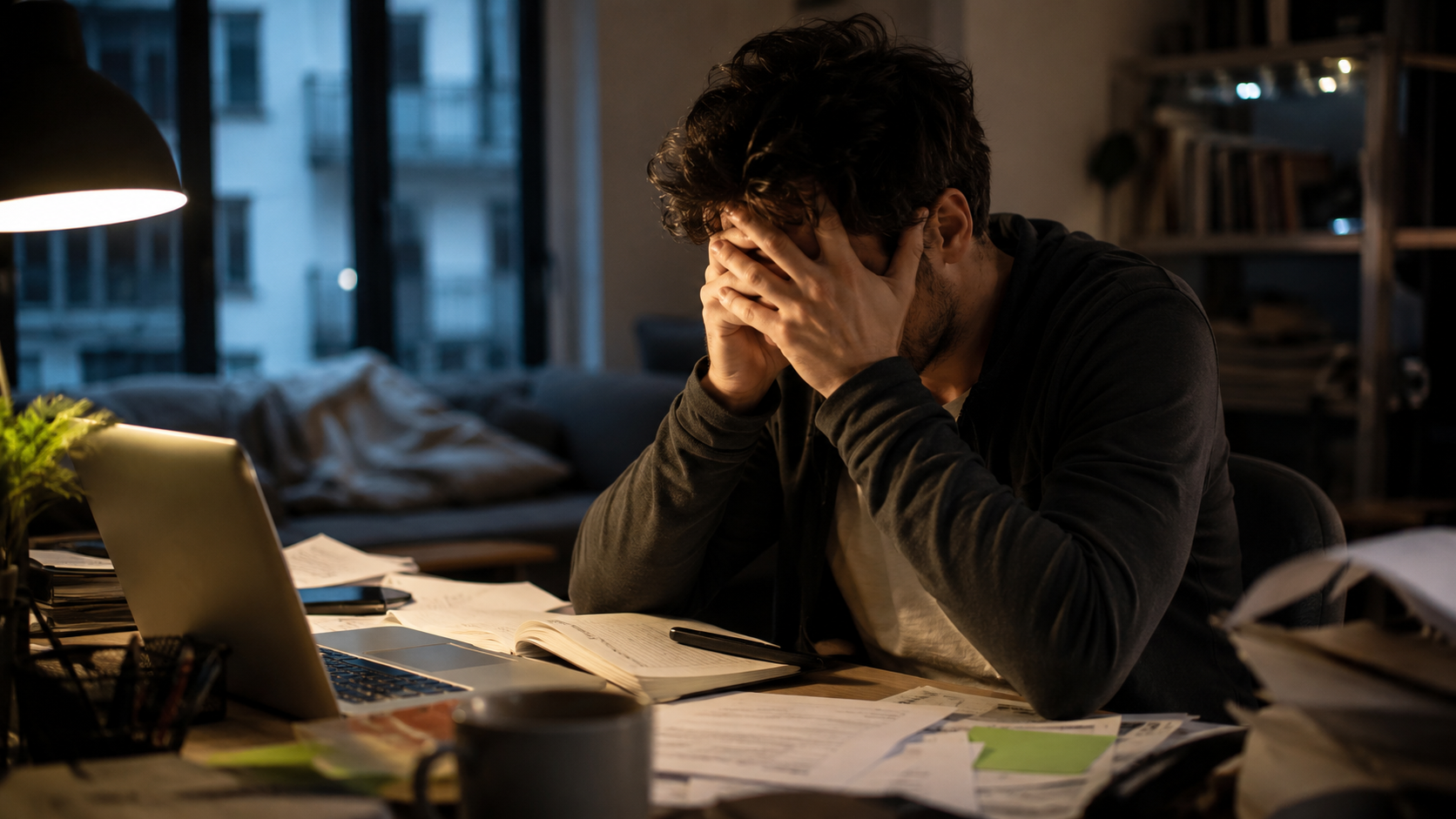
Your vision seems less comfortable when work becomes intense. Text becomes harder to hold clearly, your eyes begin to ache, or you catch yourself squinting at a screen that looked fine earlier.
That does not automatically mean stress has damaged your eyes or changed your prescription.
Stress can make vision feel worse by changing how you perform a visual task. You may stare longer, blink less completely, lean closer, tighten your jaw and shoulders, ignore early discomfort, and keep focusing at one distance without recovery. Stress can also make existing dryness, headaches, light sensitivity, and visual fatigue harder to tolerate.
The symptom is real. The explanation, however, may involve the conditions surrounding vision rather than a sudden change in the eye itself.
Stress Can Affect Visual Comfort Without Damaging the Eyes
Clear and comfortable vision depends on more than optical sharpness.
It also depends on:
- a stable tear film
- accurate prescription correction
- comfortable focusing
- coordination between both eyes
- visual attention
- suitable lighting
- viewing distance
- posture
- enough variation and recovery during near work
Stress can disturb several of those conditions at once.
When a task becomes urgent, you may stop moving naturally. Your attention narrows, your head moves closer to the screen, your shoulders rise, and the task continues long after the first signs of discomfort appear.
A controlled laboratory study examined young adults performing computer work under visual glare, psychological stress, and combined conditions. Psychological stress produced more forward-bent posture and a temporary increase in trapezius muscle activity. Glare affected blink rate and posture.
Research: Visual and Psychological Stress During Computer Work
The study does not prove that stress directly causes blurred vision in everyone. It shows something more practical: psychological and visual stressors can change how the body performs computer work.
That change may be enough to make an already demanding visual task feel worse.
Stress Can Reinforce Poor Screen Habits
Screen concentration can alter blinking and increase the time spent staring at one near target.
Stress often makes that pattern more rigid.
You may:
- delay breaks because the task feels urgent
- blink incompletely while concentrating
- keep working after the eyes begin to feel dry
- hold a phone or screen closer
- reread difficult material without looking away
- remain in one position for too long
Blinking helps redistribute the tear film across the surface of the eye. That tear layer supports comfort and contributes to a smooth optical surface.
When the tear film becomes unstable, vision may fluctuate. Text can appear slightly smeared, contrast may feel weaker, and clarity may briefly improve after a complete blink.
A comprehensive review of digital eye strain identifies altered blinking, tear-film disturbance, prolonged near work, poor ergonomics, and uncorrected visual problems among the factors that can contribute to screen-related symptoms.
The careful conclusion is not that stress automatically dries the eyes.
It is that stress can prolong and intensify the behaviours that already make dryness and visual strain more likely.
Tension Around the Face and Neck Can Add to the Strain
People often describe eye strain as though the eyes are working alone.
In reality, screen work involves the head, neck, shoulders, jaw, breathing pattern, and viewing distance.
Under pressure, you may begin to:
- push the head toward the screen
- narrow the eyes
- clench the jaw
- raise the shoulders
- hold the neck rigid
- keep the forehead tense
- remain motionless while concentrating
These behaviours do not necessarily change your eyesight. They can, however, increase discomfort around the eyes, forehead, temples, neck, and shoulders.
Once the task becomes physically uncomfortable, maintaining attention becomes harder. You may reread more, lean closer, and try harder to force clarity.
That creates an important distinction:
Your prescription may be unchanged while the experience of seeing becomes more strained.
A screen can remain technically visible while becoming increasingly unpleasant to use.
Stress Can Make Attention Less Flexible
Stress does not only affect the body. It can also change how attention is allocated.
When you are calm, attention can move between the text, the wider screen, the room, your posture, and early signs of fatigue.
Under pressure, attention may become more fixed on the immediate problem. You keep staring at the same paragraph, spreadsheet cell, or detail because finishing the task feels more important than responding to discomfort.
Research on acute stress and executive function suggests that stress can impair working memory and cognitive flexibility, although its effects vary across tasks and individuals.
Research: The Effects of Acute Stress on Core Executive Functions
That does not mean stress literally traps the eyes in one position.
It means the mental ability to shift strategy, notice competing signals, and step back from the task may become less reliable.
In practical terms, you may realise much later that you have been squinting, holding your breath, or staring without a proper break.
Stress Can Increase the Burden of Existing Symptoms
Visual symptoms are influenced not only by what is happening at the eye surface, but also by fatigue, sleep, attention, mood, and how the nervous system processes discomfort.
That does not make the symptoms imaginary.
Systematic reviews have found that anxiety and depression are more common among people with dry-eye disease and that anxiety is associated with greater reported dry-eye symptoms. However, measured dry-eye signs and reported symptom severity do not always move together, and the research does not prove a simple one-way cause.
Research: Dry Eye Disease and Psychiatric Disorders: A Systematic Review and Meta-Analysis
The relationship may run in both directions:
- persistent eye discomfort can increase stress
- stress can make discomfort harder to tolerate
- poor sleep can worsen both
- fear about vision can increase symptom monitoring
- repeated checking can make every fluctuation feel significant
The correct conclusion is not, “It is all psychological.”
The correct conclusion is that stress and visual discomfort can reinforce one another.
A symptom does not become fake because attention influences how strongly it is experienced.
Why Forcing Clear Vision Can Make Tension Worse
When vision feels unstable, the natural reaction is often to try harder.
You may squint, stare, widen the eyes, lean forward, or repeatedly test whether the image has become clear.
Some of these actions can sharpen the image briefly. Squinting, for example, may temporarily reduce blur.
But constant effort adds facial tension and keeps attention locked onto the symptom.
A simple loop can develop:
- Vision feels slightly uncomfortable.
- You become concerned about the change.
- You stare, squint, or test the vision.
- Tension and monitoring increase.
- The discomfort becomes harder to ignore.
This does not prove that the original symptom was harmless.
It explains why repeated checking can add another layer of strain without correcting the cause.
The detailed relationship between forcing clarity and visual tension will be explored in a later article. Here, the useful rule is simpler: do not turn every fluctuation in clarity into a strength test for your eyes.
Stress May Be Exposing an Existing Visual Problem
Stress does not need to create a problem from nothing.
It may reveal an issue that was already present but easier to tolerate under better conditions.
Possible contributors include:
- an outdated prescription
- astigmatism
- dry-eye disease
- contact-lens discomfort
- focusing difficulty
- problems coordinating both eyes
- migraine
- glare sensitivity
- prolonged near-work strain
When you are rested, working slowly, and taking breaks, you may compensate reasonably well.
Add poor sleep, deadlines, extended screen time, and physical tension, and that compensation may become less reliable.
This is why recurring symptoms should not be explained only through stress management.
Relaxation cannot update a glasses prescription. Better breathing cannot treat every ocular-surface problem. A calmer mindset cannot rule out migraine, eye disease, or a binocular-vision issue.
Stress may be part of the picture without being the whole picture.
How to Tell Whether Stress Is Contributing
You cannot diagnose the cause through self-observation, but patterns can help.
Notice whether the symptoms:
- worsen during demanding or time-pressured work
- ease after the task ends
- increase alongside jaw, neck, or shoulder tension
- appear after long periods without looking away
- improve after several complete blinks
- become more noticeable after poor sleep
- appear mainly during anxious periods
- return even when you are rested and calm
Stress is more likely to be contributing when symptoms reliably rise and fall with workload, tension, fatigue, and recovery.
It is less convincing as a complete explanation when the visual change:
- remains constant
- steadily worsens
- consistently affects one eye
- occurs independently of stress
- includes significant pain or redness
- involves double vision
- causes a noticeable loss of vision
Do not turn every visual symptom into an emotional problem.
But do not ignore the work conditions that repeatedly make it worse.
What Can Help in the Moment?
The aim is not to “relax hard enough” to fix your eyesight.
It is to remove unnecessary load from the task.
Stop forcing the image
Release squinting, forehead tension, and repeated clarity checking.
Look away from the screen and allow your attention to move to another distance.
Perform several complete blinks
Blink slowly and naturally, allowing the eyelids to close fully.
Do not squeeze the eyes shut.
If clarity briefly improves, tear-film instability may be contributing. That is useful information, not a diagnosis.
Change the visual distance
Look toward something genuinely farther away rather than shifting from a laptop to a phone.
This does not correct refractive error. It simply changes the focusing demand.
Reset your position
Move the screen or chair rather than continuing to move your head closer.
Release the jaw, lower the shoulders, and allow the neck to return to a more neutral position.
Reduce the task demand
Increase text size, reduce glare, close unnecessary windows, and work on one clear task.
A stressed visual system does not improve when twelve browser tabs begin competing for custody of your attention.
Stop if the symptom continues to worsen
Pushing through increasing blur or discomfort is rarely productive.
A proper pause may cost less time than rereading, correcting mistakes, and fighting the symptom for another hour.
What Helps Over the Longer Term?
If symptoms repeatedly appear during pressured work, one perfect break will not solve the pattern.
Longer-term changes may include:
- shorter periods of uninterrupted near work
- regular changes in viewing distance
- larger text
- more comfortable screen positioning
- reduced glare
- fewer visual distractions
- breaks taken before symptoms become strong
- better sleep timing
- less late-night screen use
- attention to contact-lens comfort
- reducing direct airflow toward the eyes
- an updated eye examination
It can also help to track the pattern for one or two weeks.
Record:
- the task
- time of day
- screen duration
- sleep the previous night
- stress level
- posture
- contact-lens use
- how long the symptom lasted
- what helped it settle
The point is not to monitor every blink like a laboratory technician.
It is to identify repeatable conditions.
Visual Comfort Is Part of a Larger Performance System
Stress-related visual discomfort rarely stays isolated.
When vision feels strained, reading slows down. When reading slows down, frustration rises. As frustration rises, attention becomes more rigid and the body becomes more tense.
What looks like one eye problem can become a wider performance loop.
The MindTecton approach looks at how vision, focus, reading, memory, and daily rhythm interact during real work. The goal is not to explain every symptom through stress. It is to improve the conditions under which the whole system operates.
Explore See Clarity Now for a structured approach to visual habits, comfort, and eye–brain performance.
The program supports better habits and working conditions. It does not replace prescription correction, diagnosis, an eye examination, or medical care.
When Visual Changes Need Professional Attention
Arrange an eye examination when:
- the symptoms repeatedly return
- blur remains after the stressful task ends
- one eye consistently seems different
- headaches or discomfort interfere with work
- glasses or contact lenses no longer provide stable clarity
- dryness, burning, or light sensitivity becomes persistent
- you have not had a recent eye examination
Seek urgent medical assessment for:
- sudden loss or blurring of vision
- significant eye pain or marked redness
- sudden double vision
- new flashes or a sudden increase in floaters
- a dark curtain or shadow in the visual field
- visual change after an injury
- visual symptoms accompanied by weakness, confusion, severe dizziness, or difficulty speaking
The American Academy of Ophthalmology also notes that extreme stress and hyperventilation can sometimes produce temporary blur. That possibility should not be used to dismiss sudden or unusual visual changes.
Guidance: Surprising Links Between Stress and the Eyes
Stress may worsen how vision feels. It should not be used to explain away persistent or concerning symptoms.
Final Takeaway
Stress can make vision feel worse without directly damaging the eyes.
It can change posture, intensify poor screen habits, make attention less flexible, increase physical tension, and make existing dryness or discomfort harder to tolerate.
But stress is a contributor, not a universal diagnosis.
Reduce the surrounding load. Stop forcing clarity. Change the visual conditions. Notice whether the symptom recovers normally.
If it does not, the answer is not more relaxation. It is proper evaluation.
Find the Layer Creating the Most Friction
Visual tension may be the main issue, or it may be interacting with focus, reading, memory, and daily rhythm.
Take the MindTecton Assessment to identify which layer is currently creating the most friction in how you work, learn, read, remember, and perform.
Sources
- Mork R, Falkenberg HK, Fostervold KI, Thorud HMS. Visual and Psychological Stress During Computer Work in Healthy Young Females: Physiological Responses. International Archives of Occupational and Environmental Health. 2018.
https://pubmed.ncbi.nlm.nih.gov/29850947/ - Kaur K, Gurnani B, Nayak S, et al. Digital Eye Strain: A Comprehensive Review. Ophthalmology and Therapy. 2022.
https://pubmed.ncbi.nlm.nih.gov/35809192/ - Basilious A, Xu CY, Malvankar-Mehta MS. Dry Eye Disease and Psychiatric Disorders: A Systematic Review and Meta-Analysis. European Journal of Ophthalmology. 2022.
https://pubmed.ncbi.nlm.nih.gov/34935549/ - Wan KH, Chen LJ, Young AL. Depression and Anxiety in Dry Eye Disease: A Systematic Review and Meta-Analysis. Eye. 2016.
https://pubmed.ncbi.nlm.nih.gov/27518547/ - Shields GS, Sazma MA, Yonelinas AP. The Effects of Acute Stress on Core Executive Functions: A Meta-Analysis and Comparison With Cortisol. Neuroscience and Biobehavioral Reviews. 2016.
https://pubmed.ncbi.nlm.nih.gov/27371161/ - American Academy of Ophthalmology. Surprising Links Between Stress and the Eyes.
https://www.aao.org/eye-health/tips-prevention/anxiety-stress-dry-eye-glaucoma-iop